This began with the aim of making 3D printing an enrichment to the maths curriculum.
While searching I came across this article, 3D printed maths art: 10+ examples. Their number one example was the Sierpinski Pyramid, so lets run with that.
You can find it on thingiverse,
Sierpinski pyramid. The animated gif shows how it is made:
The Summary at thingiverse says:
It has the astonishing property that the horizontal cross sections are simply connected and change continuously with height, so can be printed perfectly with spiral mode (or single-walled without infill).
This fractal is half of the octahedron flake (or Sierpinski octahedron). Every triangular face is a Sierpinski triangle, and the base of the pyramid is (approximately) a space-filling curve called the Sierpiński curve. Figures like the Vicsek fractal also exist in this model.
I must admit that I didn’t understand “spiral mode” and went ahead just by setting infill to 0%. Fortunately, this worked well. Later on I went back and looked up “spiral mode” and I now understand it.
The image at the start shows the 3 different sized pyramids I made on my Prusa MINI+. The small version took roughly 1 hour; the medium version roughly 5 hours; and the large version required 29 hours!!
Here are some progress images of the larger version print:
Further Sierpinski Pyramid possibilities (thingiverse remixes):
Fractal Pyramid Lamp and Base
I really loved the look of the fractal pyramid and wanted to turn it into a lamp so i designed a base for it that will house a led strip and print the pyramid with transparent filament to turn it into a lamp. I imagine a glow in the dark filament would work pretty well too. Color of the base is whatever you choose, I recommend using some variation of Silk filament for its reflective properties.
How was the Sierpinski Pyramid made?
Years ago I learnt recursion from
Brian Harvey's Logo books. Here is a link to a recursive
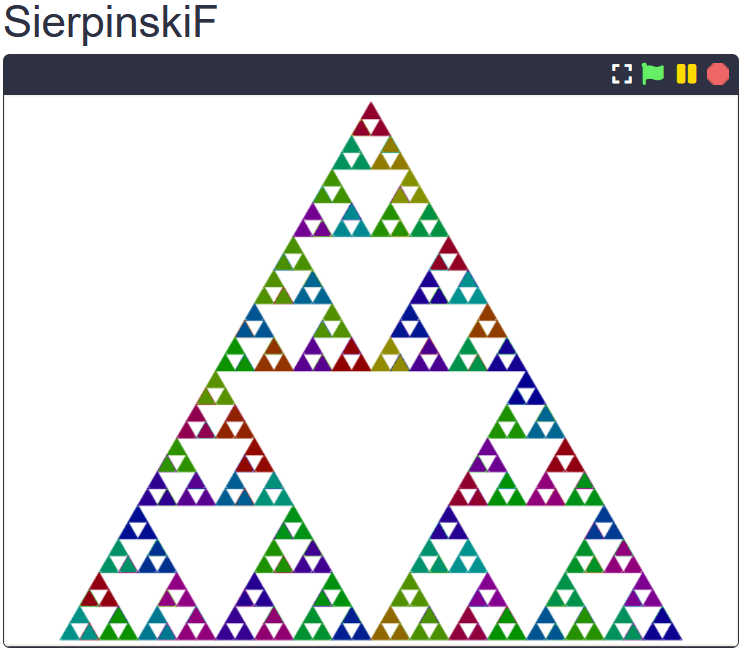
2D Sierpinski triangle on the Snap site. Brian is one of the Snap developers.
I just did a simpler one myself (
here), without colour or pen size variation. Here's the code:
The making of the 3D version is not explained on thingiverse. The best link I've found so far for the 3D making is this article / poster,
Visualizing Fractals Using 3D Printing
Some Further research:
Wolfram language:
Sierpinski Mesh
Math Art: Search in thingiverse for the label “
math art” (793 things) or “
mathematical art” (143 things) and you’ll find lots of possibilities.