Showing posts with label games. Show all posts

Thursday, April 18, 2019

remember space invaders?

I found this on a wall in Brown St, Alice Springs:

Monday, February 18, 2008

projects or games?

I think it's better that we ask our students to create projects rather than games

This represents a trade off between motivation (games are more motivating for some) and a curriculum based more on educational principles

Motivation is very important. But if the teacher leans too far towards the motivation principle they may well lose their authority to introduce other important educational content into the mix. Teacher authority? Well, yes, teachers ought to use their authority to do what they think is best.

This also represents a change in my thought that computing as such and programming in particular ought to be some sort of "centre of gravity" to one where I see science and maths as a more important "centre of gravity"

Hence, this year I have gone back to teaching as a Middle School maths / science teacher as well as a senior school computing teacher

This is also represented in a shift in my current programming software of choice from Game Maker (focus on games) to Scratch (focus on projects)

So tonight, I've been reworking an old Game Maker worksheet into a Scratch Project worksheet.

As well as the global replace, "game" with "project", what has disappeared off the worksheet? Some questions about configuration (Can the player configure the game to suit themselves – such as alter the backgrounds, music, difficulty, character?), emotions invoked, the quality of the game play and some hints about good game design.

What has stayed on the worksheet and been transformed in this process? Some questions about the quality of help, educational goals, fun factor, interactivity, ideas and things like that.

These criteria are also influencing the projects that I pick and provide to the students for them to critique. I don't pick something because it has good game play but I look for some other broader educational objective. I searched the Scratch site for projects using the tags maths, science and simulations, not games or animations. And I will ask my students to produce an educational project to teach a real person something and not a game. This will lead to some interesting conversations when some students will ask, "Can I build a game?"

I think developing a scientific world view is a more important educational goal than computer programming as such.

related:

in general programmers are not creatures of the enlightenment

the decline of IT in education

comparing game maker with etoys / squeak
Interesting to compare my current thinking with points 1,2 and 3 of this earlier post (April 2007)

Something is making me do it (September 2005)

Sunday, May 27, 2007

New types of games will be developed on the OLPC

New types of games will be developed on the One Laptop Per Child, exploiting its unique features

An OLPC Game Jam (game design and programming event) will be split into four development tracks centered around a particular hardware or end-usage aspect of the laptop:
  • Mesh Networking: Each XO has mesh networking capabilities that allow it to broadcast and connect to any laptop around it, allowing activities to easily be made collaborative.
  • Camera: Each XO has a videoconferencing-quality camera embedded to the side of its display.
  • Tablet Mode: The XO laptop has a distinct tablet mode where the screen can output high-resolution b/w graphics in sunlight conditions and features built in game-pad like buttons. This mode might lend itself to specific styles of play including one involving real-world activity beyond a confined space.
  • Malleable Games for Learning: A key consideration of the OLPC effort is certainly learning. However, more importantly it is hoped that kids can use the laptops to create their own games and experiment deeply with learning games by having access to modify and change them as part of a learning process. This track will elicit games that speak to this ideal.
"There aren't too many games right now that take advantage of mesh style networking," said Klein, referring to the XO's ability to use Wi-Fi to communicate with other users up to a kilometer away, and display them as icons on its Sugar interface. "There are networked games, sure, but they aren't sensitive to the ability to display the presence of other users depending on where they are in relation to you, or to pop up on the screen when they are close enough."
More information at hackronym and yahoo news

Monday, April 23, 2007

Comparing Game Maker with Etoys / Squeak

Game Maker is far more popular than Etoys / Squeak as revealed by a rough and ready Google search:
  • Game Maker 27.7 million hits
  • Etoys 2.5 million hits
  • Squeak 5.7 million hits

More significantly, the Game Maker forum is very active. I just went there and there were 149 current active users. I've recently subscribed to the Squeakland forum and receive one or two messages a day. No comparison.

Why is Game Maker far more popular than Etoys / Squeak? From the following comparisons it seems clear to me that Etoys / Squeak is a superior program which has been poorly promoted and which also has some quirks that slows its uptake.

1) The name. Game Maker makes a direct appeal to the millions who want to make games. This is a significant but achievable challenge, to make a game. To whom does the name Etoys / Squeak appeal to? Hard to say but it doesn't quite cut it.

2) With Game Maker the concept is simple, clean and appealing. It does one sort of thing and does it well.

On the other hand, while Etoys is developed for young people (with its drag and drop features) the concept is not so clear. You can make games with Etoys but that is just one of many things you can do with it. Moreover, this other stuff is not very clear from the website. Initially, there is just vague talk about "multimedia"

Apart from Etoys, Squeak itself is a multifaceted, ambitious program which branches out into Seaside (dynamic web apps), Croquet (collaborative 3D multi-user online applications), Sophie (digital media assembly tool) and others

With Game Maker all the energy goes into developing Game Maker. With Squeak, the energy goes in all sorts of directions, not just Etoys.

3) Mentioning either of the words Education or Learning is potentially a big turn off for young people. The Game Maker website front page does not make this mistake. But the Squeakland website falls straight into it, with it's banner "come play and learn with us"

4) Documentation and Tutorials.
With Game Maker these are clearly presented with comprehensive tutorials available and labelled for different skill levels: Beginner, Intermediate, Advanced.

For Etoys the English website (Squeakland) is a dogs breakfast with bits and pieces scattered more or less at random throughout the site. It took me many visits to put it all together.

5) Platform.
Game Maker is Windows only whilst Etoys / Squeak runs on all platforms

6) License and development community.
Game Maker is Proprietary, Etoys / Squeak is free and open source. The main developer is Mark Overmars and he has been very energetic in bringing out 7 versions in as many years. It is evident that the Etoys / Squeak development process is much more messy, with no benevolent dictator stepping forward (as there is for some other FOSS communities). This 2004 paper by Ned Konz is a frank assessment of some of the problems within the Squeak development community.

7) Drag and drop
Both programs have great drag and drop features to help a beginner make a quick start. I would say the Etoys version is superior because the variables can be seen on the same page as the animation (and even altered while the program is running, due to Squeak's late binding)

8) Multilingual diversity.
Game Maker is available in Dutch and English. Etoys / Squeak is much broader than that and attempts to reach all audiences. The Site Map page of the Squeakland site boasts links to communities in Japan, Germany, Spain, Nepal and Brazil.

9) Philosophical and educational base
Prof Dr Mark Overmars teaches Game Making at Utrecht University in the Netherlands and is clearly an expert in that area.

Alan Kay (the head of the Smalltalk team from which Squeak / Etoys arose) would have to be classified as one of the most original and creative thinkers of our time both for his own inventions and extraordinary breadth and depth of knowledge

10) User Interface
Game maker has a conventional Windows UI

Etoys / Squeak uses the innovative Morphic UI, which most users have not seen before. Morphic is great once you get used to it but it is different from what is currently running on 95% of the world's computers.

11) Web
Game maker games do not run on the web. Etoy projects do.

12) 3D
Both Game Maker and Squeak have 3D but the 3D in Squeak, which looks superior, is not currently part of Etoys.

13) Quirks
Game maker is a specialist but conventional Windows program

Etoys / Squeak has quite a few quirks. eg. on the Windows platform you have to use the middle mouse button to see the morphic haloes

14) OLPC
Unlike Game maker, Etoys / Squeak is being distributed on the One Laptop per Child Project, which might solve some of its current distribution problems :-)

Sunday, November 26, 2006

africa map game

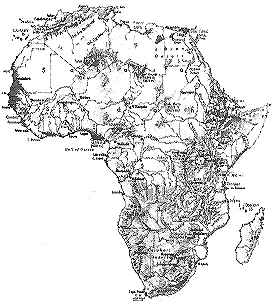
I've released version 1_1 of the africa map game on the africaGame wiki, here. There is an executable version there too if you can't be bothered downloading game maker. Thanks to Roland and Sandra for their feedback.

Improved Version 1_1. The names of the countries appear as you return them and a sound plays, there is a "what's left" button, the difficulty buttons are moved off the screen during game play and the 4 islands are different colours and now have templates to assist their location.

As well as the african students (who like it) I showed the SOSE faculty at school and Barry came up with a great idea for an extension: A colonial history of Africa. This could be an adaptation or extension of the map game. Go back in time and start off with an old map of Africa, carved up by the colonial powers. Then over time the map changes, the names of the countries change. Could be a good way to represent important historical events in Africa. How to incorporate general knowledge and colonial history into the game play?

Wednesday, November 15, 2006

new game design tool


Fascinating blog by Ian Bogost about a new game design tool being developed by Eric Zimmerman, James Gee and Katie Salen.

I chatted to Tony about this who was disappointed that they weren't using existing tools such as Game Maker for their research.

The way I see it is that game design and programming are different sorts of things and that student game development is more stuck at the design phase, where students usually just try to build a clone or slight variation of an existing game. Students don't usually do original game design work.

My current thoughts are:
  • by taking the work out of learning programming and visual representation they hope to focus more on the design aspects of developing a game, which they see as the rules of the system - the demands of learning to program can be a drag / brake on design elements, particular for students who find programming difficult
  • I think it would be a huge step forward if we had better tools to teach and communicate about design - the bit they say about rules being central is impt I think, I've been fumbling around looking at UML (visual rep) and design patterns (which might be a bit like rules)
  • some people use UML diagrams as a programming blueprint although Martin Fowler, the author of UML Distilled (my review) doesn't like this approach, it is still an approach, ie. diagram input --> code output - they might have something similar in mind, but using rules not a visual
  • in industry the designer (the ideas) are more important than the programmer and there is a division of labour in the production process
  • it seems to be a new sort of approach, different from the 3 Ecks:
    1. have students build games from scratch;
    2. have educators and/or developers build educational games from scratch to teach students;
    3. integrate commercial off-the-shelf (COTS) games into the classroom

what lies beyond gun, car and run in games?

Game design is a field about which I have a lot to learn. But I do get the impression from some experts (Zimmerman, Koster) that currently there is a market driven commercial log-jam from which something more creative and interesting than gun, car and run will emerge. We don't know what.

Eric Zimmerman, interviewed by Gamasutra:
Gamasutra: Any gaming trends that are exciting or bothersome?

Zimmerman:
Well, I could talk about the increasing homogenization of the field of commercial games. That's sort of an old song, but I still think it's true. If you go to E3 where Sony and Nintendo have their booths and stand everywhere, you can see hundreds of screens at once, and they almost all look exactly the same in the sense that they're all 3D spaces with a horizontal plane in the middle and an object in the lower center of the screen. It might be the barrel of a gun, a vehicle, a person running. And it's amazing, considering how with today's technology we can really put almost anything on-screen, that there's such a structural homogeneity, both terms on aesthetics and in terms of content, but especially in the structure of the gameplay... it's shocking. But it's also hard to innovate. And as I said, that's both a business dilemma and a creative or design dilemma....

... there are great huge, unsolved problems in games. In other words, the subject matter that we see depicted in games is relatively narrow. Scott McCloud talks about what he thinks about what comics could depict or could do as a medium and what they have done, and he sees it like we've seen a little narrow slice and there's this whole huge world, and I think it's even more true about games.
Eric Zimmerman and Katie Salen are co-authors of Rules of Play. I haven't read this but I liked this review by K. Sampanthar "kes_sampanthar" at amazon, which outlines the following interesting parts of the book:
- Reiner Knizia - writing about how he designed the Lord of the Rings Board game
- Richard Garfield (Sibling Rivalry), Frank Lantz (Iron Clad), Kira Snyder (Sneak) and James Ernest (Caribbean Star) - design board games for the book and each of them describe how they went about designing. (Note: James Ernest's game Caribbean Star is available as part of a game collection he released from his company Cheapass games - check out "Chief Herman's Next Big Thing" )
- There are game design exercises that students or teachers can use to learn more about each of the concepts. These exercises are split into 3 categories: game creation, game modification and game analysis.
- Complexity, Emergence, self organization as they refer to games
- Probability and Randomness (luck) in games
- Information Theory - uncertainty, noise and redundancy
- Systems of Information - public and private information
- Cybernetics - Feedback loops and game balancing
- Game Theory - Cake division and the prisoner's dilemma
- Conflict and Cooperation
- Interactivity
- Flow - Entrainment, reward schedules, behavior theory and addiction
- Edward De Bono's L Game
- Narrative play - story arcs etc..
- Simulations - games as simulations
- Metagames - the larger social context of games
- Open Source Games - like Icehouse
- Game modifications - Alterations, Juxtapositions, Reinventions
- Blurring the boundary between "real" and "play"