Showing posts with label ACARA. Show all posts

Tuesday, January 12, 2021

don't separate the what from the how

Who is Mitch Resnick? He is a leader of the amazingly successful Scratch site, which has many millions of great projects developed by a mainly young community of coders. It also has a very well thought out interface which helps teachers like myself keep track of their classes and students work.

I'm summarising here some of Mitch Resnick’s insights into criteria to use in teaching digital technology:
  • The maker movement and the coder movement fosters creativity far more than using computers for delivering and receiving information
  • Computational participation is a better guiding framework than computational thinking. Computational participation is broader in that it includes personal expression, creative design and social engagement.
  • Our aim should be that our students think, “I want to do this!”, far more motivating than the self efficacy aim that our students think, “I can do this”
  • Curriculum reform ought to be changing what we teach, eg. design a project around an idea or interest, not only how we teach

These points can be combined with those made in an article by Mitch Resnick and Brian Silverman which I summarised 18 months ago (how to evaluate construction kits: ten design principles)

In that article I'm thinking, in particular, of point 2 wide walls; point 3 make powerful ideas salient, not forced; point 5 keep things as simple as possible; point 7 a little bit of coding goes a long way, and, point 10 iterate, iterate and iterate again as a design principle

Taken together, these points are a powerful critique of the ACARA curriculum guidance approach which read this way:

YEAR 7 AND 8 CONTENT DESCRIPTIONS

  • Design algorithms represented diagrammatically and in English, and trace algorithms to predict output for a given input and to identify errors (ACTDIP029)
  • Implement and modify programs with user interfaces involving branching, iteration and functions in a general-purpose programming language (ACTDIP030)

This could be critiqued as boring wooden language generalities but it's worse than that. ACARA tells us what without the how. The what and the how should not be separated but rolled together in an engaging package taking into account where the learner is starting from.

So, in practice, schools dodge around ACARA by tying up their teachers with mainly meaningless paper work for the audit and then if any energy and understanding is left over letting them get on with the interesting stuff.

So, what is both laughable and tragic is that Mitch Resnick still has to argue these principles with Mark Guzdial (who in the end admitted Resnick was correct) because in Guzdial's words the whole education system is permeated with the philosophy that Thorndike won, Dewey lost, that is we are stuck with standards based education, rather than education that stimulates the natural curiosity and capabilities of children.

Reference:
Kafai, Yasmin B and Burke, Quinn. Connected Code: Why Children Need to Learn Programming (2014), Forward by Mitchel Resnick
The first goal of a CS course should be to promote confidence ...(see comments 2, 3, 11, 13, 14, 15 and 16 for discussion b/w Mitch Resnick and Mark Guzdial)
Thorndike won, Dewey lost

Wednesday, July 03, 2019

bee waggle project with the Hummingbird Bit

I conclude here that this is a better and less expensive pathway for soft technological artistry than LEGO Mindstorms


This is my first Hummingbird Bit project. It was a fun project. The Hummingbird Bit has an outstanding design.


I had to explore the input and output features of the Hummingbird Bit. The important ones for this project were the position and rotation servo outputs.


Then I had to buy the materials and build the bee. Finally, I had to code the bee to point and waggle.


I've also done an evaluation of how it maps onto the ACARA Digital Technology curriculum and how that process could be made more interesting.

BUILDING THE BEE

The lesson plan provided by BirdBrain suggests that the teacher builds a sample bee beforehand and shows it at the right strategic moment to help the students get on with it. The main challenge in the lesson in the BirdBrain design (where less help is provided) comes in the coding section.


Issues: Hummingbird projects employ craft materials and so end up more diverse and less "blocky" than your typical LEGO projects. Lets call that soft technological artistry, aka STEAM rather than STEM.

CODING THE BEE

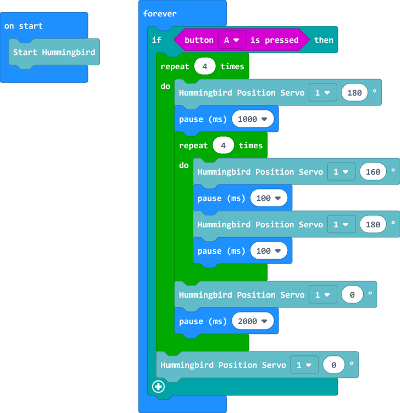
If you look at the Attenborough video you see the bee attracts an audience, points, waggles, walks around clockwise, waggles again, then walks around anti-clockwise waggles again etc.

So, initially I opted for the rotation servo because it can move through the full 360 degrees whereas the position servo can only move through 180 degrees.

This, however, was not the best move because of some quirks in transferring code (which makes logical sense or at least I think so) into the physical world. There is a problem here I haven't solved yet but won't go into details because it would take up too much space. Is there a Help Group for such problems, I'll look later.

So, in the end I opted for the position servo despite it's limited functionality in only being able to rotate 180 degrees. The bee turns out to be a smarter coder than me!


ACARA CARDBOARD

Can't help it. From the year 7-8 Design Tech curriculum here are some of the objectives which are covered or could be covered depending partly on how this project is organised in the classroom:
  • Define and decompose real-world problems taking into account functional requirements and economic, environmental, social, technical and usability constraints (ACTDIP027)
  • Design the user experience of a digital system, generating, evaluating and communicating alternative designs (ACTDIP028)
  • Design algorithms represented diagrammatically and in English, and trace algorithms to predict output for a given input and to identify errors (ACTDIP029)
  • Implement and modify programs with user interfaces involving branching, iteration and functions in a general-purpose programming language (ACTDIP030)
  • Evaluate how student solutions and existing information systems meet needs, are innovative, and take account of future risks and sustainability (ACTDIP031)
  • Plan and manage projects that create and communicate ideas and information collaboratively online, taking safety and social contexts into account (ACTDIP032)
I think an interesting way to manage ACARA guidelines would be through Talent Identification as outlined by Jennifer Cross in her PhD. I need to do some more work on that, too. In the process of completing this project I had to exercise
  • Improvisation skills in building the bee (the foam shapes I bought weren't all the right size so I returned to Mad Harry's to buy a pom pom for the bee's head)
  • Planning skills both with regard to buying materials and algorithmic planning for the code
  • Decomposition aka breaking the code into smaller bits, ie. doing the rotation through 180 degrees and the waggle sequence separately and then putting them back together
  • Pattern recognition, there is iteration (repeats) in the code for both the bee waggling and the bee rotating
  • Constraints with regard to choosing either the rotation or position servo and problems I had with the rotation servo
  • Persistence, in particular, in attempting to resolve problems with the rotation servo
In conclusion, I think a strong case can be argued for the Hummingbird Bit as a better pathway for soft technological artistry as well as less expensive when compared with LEGO Mindstorms.

REFERENCE

Introductory video showing the capabilities of the Hummingbird Bit

Program, Build, Teach and Resources for Hummingbird Bit and MakeCode

Bee Waggle video and link to lesson plans