Friday, September 15, 2023
Voting NO to The Voice
The YES vote is a grab by the black bourgeoisie aka the aboriginal industry for a bigger slice of the cake. Although the most disadvantaged people do need some sort of extra support that works I haven’t seen a good argument that the Voice will do the job. The aboriginal industry hasn’t been very successful so far. Why should giving them a permanent fixture in the Constitution improve things? This will certainly end up pissing off a significant section of Australians. I can’t see why one section of the population should have privileged access forever to those who decide things. It implies that disadvantage will never be overcome. Perhaps the task here should be to develop policies that will “close the gap” and find the people to implement those policies. This is a genuinely hard problem to solve amongst the babel of welfare dependency, grog, black on black violence, self interest, victim mentality, cultural confusion, first language issues, real difficulties of remote delivery of services and historical trauma. Interesting that some of those in the YES camp who appeared to have a good understanding of these issues have now descended to name calling (Marcia Langton, Noel Pearson). The archaic sentiments in sections of the Uluru statement are not central to the discussion. You can’t imagine Marcia or Noel longing for a return to pre colonial days. My guess is that they represent a compromise to bring the different tribes together and present a united front. But who knows?
The NO vote leaders (Jacinta Price, Warren Mundine, Anthony Dillon) do have some sort of realistic plan (although not always clearly articulated) to improve the lot of the most disadvantaged Australians (remote aboriginals). They argue that commonalities between A&TSI and the rest are more important than differences. And that the disadvantaged A&TSIs need to find the same things that the successful have already found (good education, good job, buy a house etc.). I just think they need to spell out the detail more in order to overcome the litany mentioned above.
There was a booklet called “Beyond Belief” which came out in 2022 outlining several different arguments for the NO vote. Some of it was new to me, especially the prospects of High Court interventions if The Voice advice is not adopted. Anthony Dillon (especially) and Warren Mundine have been publishing their arguments on X (formerly twitter) throughout this year.
Monday, July 19, 2021
dotted circles revisited
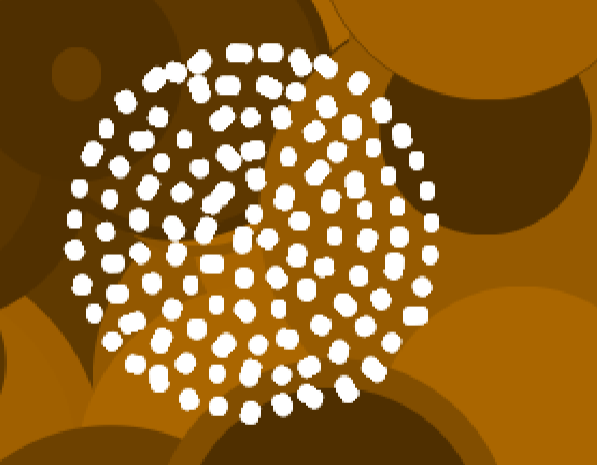
Roughly 18 months ago I did a SNAP! Project (“dotted_circles”) which was inspired by and partially imitated some aspects of Papunya Tula art.
This resembles a small portion of a work by Charlie Wartuma Tjungurrayl, Untitled, 1985, (from p. 2 unique perspectives)I'm revisiting because I cited this work, with a link, in an article, The Wider Walls, I wrote for a book which will soon be published. But when I revisited the linked to SNAP! page (dotted_circles_6) I discovered some problems.
First, you have to turn on JavaScript extensions
Second, the User Interface (UI) is so poor that I had difficulty myself working out how to draw a reasonable dotted_circles art piece. This is because, in that iteration, I gave the user more control in an attempt to more closely imitate aspects of Papunya Tula art works. The user has to draw the circles one by one changing the settings of radius, colour and any others as they go along.
So, what I've done is a new imitation from the ”Unique Perspectives” art book as an exemplar. By explaining the exemplar, I hope that will help the user figure out how to do a more varied piece of digital art.
I'll explain the code of the exemplar in some detail below.
The latest dotted circle I've done is dotted_circles_7
Partial imitation of an art work by Pinta Pinta Tjapanangka, Untitled, 1998 (p.23 unique perspectives)- Go to settings and turn on JavaScript extensions first
- Press space bar to run the exemplar
hide the dot (it still draws when hidden and we don't want a black dot when we are finished)
clear the page
set the pen to dark grey
lift the pen (don't want a line drawn yet)
go to the centre
set pen size to 600 (large, to fill the whole screen)
pen down
move 0 (the pen will draw even with move 0)
centre_dot_mustard
set the pen to mustard colour (#56)
dot size 10, lumpiness 2 (lumpy is more realistic)
move 0 (draw the centre dot)
8_lumpy_mustard_circles
set current_radius to 15
set dot_spacing to 10
pen up
set number_dots to dot_number
(dot_number is calculated by 2*pi*R / dot_spacing)
the next repeat draws the circle dots with the intended dot spacing and lumpiness
then increase the radius by 10
repeat a total of 8 times, each time the radius increases and the number of dots increases, while the spacing remains roughly the same (not quite though because of the dot lumpiness)
If you are curious about how the new blocks were made in Snap! then right click > edit on them. You will see, for example, that
dot_number = 2*pi*inner_radius / dot_spacing,
... mmm... inner_radius should have been called current_radius. So the dot_number is worked out for each new circle as the radius expands.
Snap! used to be called Build Your Own Blocks, which is one of its great strengths.
Previous:unique perspectives:PAPUNYA TULA ARTISTS AND THE ALICE SPRINGS COMMUNITY (2012)
Dotted Circle Samples
Culturally Situated Design Tools: Dotted Circles Exemplar version 2
Monday, January 20, 2020
Frontier Justice by Tony Roberts
I found a review I agreed with (here) and am quoting it in full.
Frontier Justice: A History of the Gulf Country to 1900 by Tony Roberts (2005)
Tony Roberts begins his monumental study of Aboriginal-white frontier relations by describing the harshness, remoteness and dangers of the Gulf country, a vast region stretching from the Barkley Tablelands to the Roper River in the Northern Territory and from the Stuart Highway to the Queensland border and beyond as far as Burketown. The region is centred on the isolated township of Borroloola.
As Roberts notes, this was Australia’s last frontier. Even today the area is remote and little known to most Australians. The strength of Robert’s study of frontier relations in this region is evident from the start in the deft and telling way he sets the context. During the pastoral boom of the 1880s thousands of head of cattle were driven along the ‘coast track’ from Queensland to Roper Bar and Katherine in the Northern Territory to stock the vast stations being established. There followed many hopeful individuals seeking riches in the Kimberley gold rush. Roberts notes this was ‘a momentous time in Australian history’.
However, describing the enormity of the dispossession and destruction that overwhelmed the tribes of the area in the short space of two decades, Roberts applies those same words to describe the significance of these events for Aboriginal society. He says it was ‘a momentous time in Aboriginal history’. The implication is clear – there are two histories in this country. Roberts sets himself the task of exploring both versions, and in the process throws much light on previously hidden aspects of the interaction of the two societies, settler and Aboriginal, in this remote frontier region.
Roberts’ detailed, almost forensic, examination of this relationship reveals a tragic and cruel tale. The damage inflicted, sometimes unwittingly, but all too often with callous intent, on the Aboriginal people of the region, is captured in the words of his title – ‘frontier justice’ – a title redolent with irony, as the reader becomes only too well aware as the story of the destruction wrought upon Aboriginal society is revealed.
Frontier Justice provides a detailed account of the history of the area to 1900 on a chronological and on an area by area basis. Although this approach leads to some repetition, the result is a comprehensive account. Roberts has spent 30 years researching and writing this book. It is a labour of both love and despair. The story Roberts tells is one of rape, abduction and murder of Aboriginal people by brutal whites (and Roberts makes abundantly clear that not all whites were brutal), of Aboriginal reprisals by way of killing of whites (Roberts uses the term ‘murder’), spearing of stock and setting fire to the country. The deadly cycle of reprisal, including ‘punitive expeditions’, then comes into play. Indiscriminate shooting of Aboriginal men, and sometimes of women and children, became the method of ‘controlling the blacks’. Roberts builds a strong case to show that the police were active agents in the punitive expeditions, and in particular raises serious concerns about the role played by Inspector Paul Foelsche who was in charge of policing in the northern half of the Territory from 1870 to 1904.
Roberts explains that essential to the subjugation of the Aboriginal tribes was the conspiracy of silence that prevailed. This kept the metropolitan government in Adelaide at bay as they struggled ineffectively to keep some control of the Northern Territory situation. One needed to know the code to understand what was happening – Aboriginal people were not ‘shot’, they were ‘dispersed’. When reports were written they understated the numbers killed and misrepresented the circumstances. Bushmen were not obliged to join in the hunting of Aborigines, but they were required to keep silent about what they knew. Roberts has managed to penetrate this ‘veil of secrecy’ only through an enormous research effort. He has uncovered many key documents from archives and personal possessions which have not previously seen the light of day. He has relied on a wide variety of sources, published and unpublished, including extensive Aboriginal oral history. It is a cover-up that almost succeeded.
Such a mass of information could have been overwhelming, and made such an account as this turgid and difficult. However, Roberts writes with an economy of words that repay close attention as they carry much information, directly and by implication. Writing of the punitive expeditions, Roberts notes: ‘In the fledgling Northern Territory they [the punitive expeditions] were commonplace: supported by government officials, applauded by the local press, perpetrated by ordinary men and sometimes led by senior police officials’.[1] The sentence says a lot about the nature of the Australian frontier. Roberts’ book is lengthy not because the author is wordy, but because of the mass of information it contains.
As well as punitive expeditions, casual shootings and assorted violence, Roberts describes the forced sexual mistreatment of women and children in the region. Venereal disease became rampant and was untreated. The practice of kidnapping young children left old people to fend for themselves – often destitute and starving.
However, a parade of violence, well-researched and documented as it is, would not take us far in understanding the dynamics of the frontier. Roberts shows that lying behind the self-justified and largely unchecked violence was the assumption that the Aboriginal people had no rights in the lands they had occupied for millennia. On the other hand, the whites had, apparently, the right to travel through, or even take possession of, these lands. Any opposition on the part of the Aboriginal people was seen as contrariness, treachery or criminality. This is the true psychology of terra nullius. Roberts himself pinpoints this assumption by the whites: ‘The land was simply occupied as if it were terra nullius and severe punishment was meted out to any Aboriginal who resisted’.[2]
Frontier Justice is a well-informed, closely researched and absorbing book. It is a work of detailed scholarship which manages to be objective, in the sense of a dispassionate search after historical truth, and morally engaged at the same time. Roberts does not hesitate to name moral bankruptcy. Frontier Justice strips away the romanticised view of the pioneering days which has largely served to hide the brutal and difficult realities of our past. These realities have to be faced. Frontier Justice makes a significant contribution to this task. It deserves to be in every school, university and public library.
Friday, January 17, 2020
Australia's shameful history
“This history is so shameful that most Australians could not admit that this is the origin of their state and their nation”When I grew up in Melbourne in the 1950s the history of what happened to the aboriginals was invisible. No one talked about it. As Bill Stanner said in 1968 it was the great Australian silence, a cult of forgetfulness on a national scale. A view from the window where a significant part of the landscape was hidden.
— Indigenous historian Marcia Langton, in The First Australians.
Some of my marxist comrades say something like this:
Aboriginal resistance to colonialism can’t be supported because their social system was too backward, primitive, “stone age”. Further, it is argued that Marx supported globalisation and implied from that, that he supported colonialism. See Marx Supported Capitalist Globalization According to this dialectic the British occupation of Australia was basically a good thing. Modernity is good, superior to any form of pre-modern society. Perhaps I am not portraying their position correctly. They can fix that.
What I am thinking:
This mindset filters out some uncomfortable facts. We see the world through our mind memes, the state of our mind determines what we choose to see. Hence, some of these comrades end up say that Windschuttle was correct in his denial of massacres. I've been told that historians such as Lyndall Ryan and Henry Reynolds either exaggerated or lied and never admitted it when they were caught out. I can except that but believe that their fundamental position is correct, that widespread, systematic massacres occurred.
What facts?
That there were repeated massacres of aboriginal people. Following from the terra nullius doctrine aboriginal people were not treated as having any rights. So, in Tasmania the ex convict settlers took their women. In Queensland pastoralists took their land, etc, etc. Any thinking person should be able to see that this would inevitably lead to conflict. I filter the facts through that context, terra nullius and what would have to flow from that. Aboriginal people responded by killing whites or cattle. In response the whites responded by multiple killings of aboriginals, the only viable way in the conditions of the early colonies, to “teach them a lesson”. Those doing the massacres were usually not brought to justice. Either a blind eye was turned or the massacres were kept secret from authorities.
The evidence:
I didn’t always know this as mentioned earlier. When I went to Far North Queensland (Pauline Hansen country) I learnt through reading (eg. Henry Reynolds) and talking to people that the mindset of “keeping the abos in their place” was widespread. A cleaner at Djarragun College told me that during a holiday further north a publican had told her that when driving home at night if an aboriginal was on the road the best thing to do was run them over.
At any rate, I’ve read these books which I believe provide adequate documentation of both the mindset and the facts:
All that is solid melts into air by Marshall Berman
The Politics of Suffering by Peter Sutton
The Tall Man by Chloe Hooper
* The Black War by Nicholas Clements
* Why Warriors Lie Down and Die by Richard Trudgen
* Why weren’t we told? by Henry Reynolds
* Forgotten War by Henry Reynolds
* Frontier Justice by Tony Roberts
Disciplining the Savages, Savaging the Disciplines by Martin Nakata
Cosmopolitanism by Kwame Anthony Appiah
Colonial Frontier Massacres, Map (Date Range: 1780 to 1930)
Colonial Frontier Massacres, Timeline
Colonial Frontier Massacres, Preliminary Findings
* Dancing with Strangers by Inga Clendinnen
* The Sinister Glamour of Modernity by Ross Gibson
Australian Frontier Wars: Keith Windschuttle and Henry Reynolds on Lateline (2001, 22 minutes)
Australian Frontier Wars: Keith Windschuttle and Henry Reynolds at the National Press Club (2001, 58 minutes)
* Man from Arltunga: Walter Smith Australian Bushman by Dick Kimber
Gillen's Modest Record edited by Philip Jones
Boyer Lectures 2019, by Rachel Perkins (audio)
debate between Robert Manne and Keith Windschuttle at the Melbourne Writers Festival, part one, part 2 (September, 2003)
Of these, perhaps the best documented books about the massacres (rather than the mindset) are those by Clements (about Tasmania) and Roberts (about Queensland and the NT). I mention this because I accept that everyone is busy on their own projects and doesn't have time to read everything.
I've put a * next to the books which provide evidence that it was standard practice from 1790 - 1930 to kill aboriginal and TSI that settlers had a problem with
Update (Jan 19): Added some more books and links. In particular the debate between Keith Windschuttle and Henry Reynolds at the National Press Club (58 minutes) is worth watching.
Tuesday, January 14, 2020
Dotted Circle samples
A good app IMHO. Here are some sample art works I made with my dotted_circles app. The first two are me just playing around but the bottom two are attemps to imitate a portion of aboriginal art from the exhibition book referenced at the end.
This resembles a small portion of a work by Charlie Wartuma Tjungurrayl,titled Untitled, 1985, from p. 2 (reference below)
This resembles a small portion of a work by Johny Yungut Tjupurrula, Untitled, 2011, from p. 63 (reference below)
Go to the Snap! app dotted_circles_6 and do one yourself! [but read the update below first!]
Update July 2021: First up, you have to enable JavaScript extensions. Click on the Settings icon and tick the box. Honestly, I'm not sure why this is necessary. I've looked in the Snap Forum for an explanation. Brian Harvey (bh) insisted here it should not be turned on automatically as a general principle without explaining why.
The User Interface is hard to follow on dotted_circles_6. This is because I gave the user more control in an attempt to more closely imitate aspects of Papunya Tula art works. What I now suggest is go first to dotted circles revisited.
By the way, if you are curious about how the new blocks were made in Snap! then right click > edit on them. You will see that dot_number = 2*pi*inner_radius / dot_spacing, mmm... inner_radius should have been called current_radius. So the dot_number is worked out for each new circle as the radius expands. Snap! used to be called Build Your Own Blocks, which is one of its great strengths.
/Update
Reference:
unique perspectives:PAPUNYA TULA ARTISTS AND THE ALICE SPRINGS COMMUNITY (2012)
(with the last two designs I have attempted to imitate a fraction of the art work on pages 2 and 80)
Issues arising:
My overall goal is not to imitate Papunya Tula art but to find new forms to teach maths and computer coding to indigenous students.
This is an app which builds a bridge between maths and computer code to make art. When introduced to students what will the learning outcomes be? I suspect they will learn something about design but it would take a lot more input from a teacher for the students to learn computing coding and maths from this. Nevertheless, it may motivate them to do so.
The User interface is poor. Since the user has to poke around and find the values to change in the Scripting Area. Important issue but I'm not sure at this stage how to improve it. ie. you can do good art with this app but need patience to master the user interface. Not good since UI is a huge issue.
There is a big story to tell about the Papunya Tula art movement, which I have yet to tell, although others have.
The learning theory was discussed in an earlier article: Culturally Situated Design Tools: Dotted Circles Exemplar version 2. In two phrases (1) performance above representation (2) ascend to the concrete.
Tuesday, December 31, 2019
Culturally Situated Design Tools: Dotted Circles Exemplar version 2
aka ethnocomputing
It begins like this:
and develops into this:
This began as an exploration of a good way to teach maths to the indigenous. It has turned into an integrated curriculum approach with maths as one of the important elements. The elements of integration include art, aboriginal culture, technologies including digital technology, maths and story telling
A powerful idea from indigenous culture is the circle. This was highlighted by Chris Matthews at the final session of ATSIMA 2018 (Aboriginal and Torres Strait Islander Mathematics Alliance).
The numbers (1), (2), (3) and (4) on the diagram refer to particular interfaces within the overall picture. I’ll use those interfaces to describe the approach in more detail.
(1) The interface between Indigenous Dotted Circle Art and Ascend to the Concrete.
The dotted circles are prominent in western desert aboriginal art (Papunya Tula) dating back to the early 1970s. I was surprised to discover the assertion in a couple of books by Ian McLean that aborigines invented the idea contemporary art. It makes for interesting history and I’ll have to summarise that story at another time. Dotted circle art in indigenous culture is a powerful theme, not tokenistic. Ian McLean coins the term "tribal modernism" to describe the growth of the Papunya Art movement:
The Western Desert painters remain committed to their tribal traditions. They did not abandon them for the promises of Westernism but instead insisted on the contemporaneity of their tribalism. This is perhaps the greatest shock of the art movement from an artworld perspective: it is tribal modernism. Thus it challenges the self-defining paradigms of both Western modernity and the artworld.The following example comes from a public poster about NAIDOC week:
- Rattling Spears, p. 121
(2) The interface between Maths of the Circle and Ascend to the Concrete.
Mathematical abstraction is often cited as a pinnacle of Westerm culture.
However, some authors have presented original interpretations. Ascend to the concrete comes from the philosophy of Marx. Andrew Pickering’s mangle analysis of Science speaks of the dynamic interaction between the material (machines) and humans. Epistemological pluralism, where the bricoleur approach is recognised as both valid and powerful, comes from Papert and Turkle.
By mathematical abstraction I mean, pi = circumference / diameter and the other formulae that flow from that. Mathematical abstraction is powerful, I agree with that. However, it is also a double headed beast. To abstract a circle, as in a textbook maths representation, is to oversimplify the richness of real circles found in art and nature.
Rather than dry as dust textbook maths I strive here for material based, hands on, models that will engage, motivate and educate. The long term goal is to teach maths and the computer coding of maths. But dry abstractions, learn C = 2piR, then plug in the values and get the correct answer, often does not engage or promote meaningful understanding.
How do we make the derivation of pi more concrete? One good way is the rope activity. Walk out 7 steps along a rope being held by a partner. Then walk around your partner in a circle counting your steps. If you get 44 steps then you have an approximation for pi (44/14 = 22/7). Repeat this process for different radii. Notice that the value of C/2R or C/D is always roughly the same. Why is that?
Moreover, a sprite on the computer sits at the boundary between the abstract and the concrete, a visible thing, almost tangible. Program it to move in a circle. That is abstract. Then see the sprite move in a circle. That is concrete. Add some colour and other effects, such as lumpy dots. That is enriched concrete or artistic concrete with an underlying abstraction. We have ascended to the concrete.
Snap! program estimating pi by measuring circumference and diameter
(3) The interface between Maths of the Circle and Indigenous Dotted Circle Art
How do we make the maths artistic and the dotted circle art mathematical? This can be done with computer programs such as Turtle Art, Scratch or Snap! There are various ways to draw circles on the computer. A good way to do a dotted circle was to start in the centre, lift the pen, move radius, put the pen down, draw the dot, lift the pen and return to the centre. Then turn a little and keep repeating the process. Computers are fast, one of their great strengths, so it doesn’t take long.
I spent a fair bit of time experimenting with colours of both dots and background and how to do lumpy dots, more in keeping with the art form. I am doing this for the user but the how to can be read in the code. The art and maths intermingle in a transparent process.
I got this far trying to imitate the above NAIDOC poster using Turtle Art:
(4) In the middle of the three rings above is a sweet spot, I hope. As I develop my understanding of the 3 teething rings the sweet spot becomes sweeter
My interpretation of ascend to the concrete in this context goes like this: It refers to a journey from the first exposure to a concept (eg. the circle) to an exploration of its properties (eg. pi) and then returning to the concrete circle in the world armed with a theory to put into practice (eg. understanding and using computer code to draw interesting and artistic circles)
Although it's not in the teething rings above digital technology is a wonderful device to present the abstract concretely. As well as that digital has become / is becoming the new dominant medium since you can arguably develop more powerful, more flexible and more evocative representations than in previous mediums. I have to qualify that though. Papunya Tula art is far more evocative than the puny representations I have developed so far digitally. Rather than trying to duplicate Papunya Tula art I have moved to the position of using aspects of it as inspiration to develop a new form of digital art. Each has its own strengths and weaknesses.
Here is a summary of the approach. Take a powerful idea from indigenous culture and represent it using a variety of technologies! Start with the cultural theme so that the technology serves and enables different forms of expression of the culture. ie employ and mobilise the motivational aspect that comes with tapping into personal culture. Then use technology (both digital and non digital) to make the abstract ideas within the powerful idea more concrete.
We end with an enriched circle, a rich art form. Not traditional art. Nor an abstract disembodied circle. Rather a form which has elements of both abstract maths and traditional aboriginal art. Call it indigi_maths_art. Call it tribal modernism, a mongrel of the traditional and the modern. It’s part of the work of cultural extension.
PERFORMANCE TAKES PRECEDENCE OVER REPRESENTATION
In an earlier version of this essay I talked about representing the circle in various ways. Since then, I’ve been persuaded by Pickering that real knowledge arises through performance and representation is an after the event disembodied abstraction.
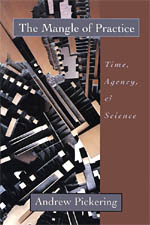
Performance is real time interaction between humans and machines to achieve a goal specified by the humans. This is a difficult path marked by resistance and accommodation to that resistance. Teachers understand this and are continually modifying their lesson plans to better fit the needs of their students. For Pickering, this is the true nature of scientific knowledge. It is part objective, part relative (or subjective) and part historical. Science is material, not just knowledge. Historically, this is true. Galileo used the telescope to help start a scientific revolution. Machines were at the heart of the Industrial revolution. Galileo’s work was dramatic performance. I am taking Pickering’s insight to help map out a performance based educational pathway. The modern machine that can assist us the most is the computer.
One goal is to master the user interface, to use the computer effectively. In developing this app I want it to be easy enough for the naive user to create interesting art quickly. And I want it to be open and transparent so the user can readily look under the hood to see how it was made.
Another goal is to teach computer coding. Computer coding has become more popular, largely through the lead provided by Scratch. Nevertheless, not all students find this easy or are led to more complex coding. Even though block coding is easier than text coding still not all students become engaged with it. This is partly a cultural issue.
To learn to code is an arduous, sometimes difficult process and the cultural image of the highly skilled computer geek is a barrier to overcome here. Why would an indigenous student want to learn to code? The answer or pathway offered here is that it provides an opportunity to create some interesting and culturally relevant art forms. Hopefully, that might enhance engagement and learning further.
Tinkering or tuning is an important part of the learning process for both teacher and student. Humans tune the machines. The machines tune the humans. This process operates on me as the developer of this software app. Does it engage the student and help achieve the long term goal of teaching maths? A curriculum is an instrument too. Try the activities, see if they succeed. They will succeed for some but not for others. Then tweak them, think of new activities. This is a never ending developmental process. One goal was to teach the maths of the circle. Pi stuff. Are we succeeding?
Some of the many possible performances (previously I said representations) with which I have made some progress so far include:
- The art itself (dotted circle theme). I have looked at the art and bought some books about it. I've yet to actually do the art myself but am looking for that opportunity
- Language English: Tell the story of the Papunya Tula art movement and find out what the circles represent
- Humans with rope, make a dotted circle or just a circle. This can be used to estmate pi concretely.
- Snap! program estimating pi by measuring circumference and diameter.
- Turtle art: For artistic effects and special fast primitives, such as arc, with the 2 inputs of angle and radius, arc: angle radius, see first iteration of a NAIDOC week poster using Turtle Art
- Scratch application, see dotted_circles_version_1
- Scratch: Cloning circles. I've done this in other contexts and it could be adapted to this context.
- Snap! and Scratch compared: Hal Abelson's objective ("programs must be written for people to read, and only incidentally for machines to execute") can be achieved more readily with Snap! than with Scratch. See a comparison between Scratch and Snap!
- Snap! application, see dotted_circles_4
This artwork was made with the Snap! application, dotted_circles_5 Click on the link and do your own performance.
Another Snap! application work of art: Here are some more possibilities which I have thought of but haven't attempted to implement yet:
- Language Pintupi / Luritja: introduce some
- App Inventor: dotted circle with one phone or many phones
- Photography: Show some pics of dotted circle art, perhaps from overhead using a drone
- Robot (which robot?) draws the dotted circle
- Microbit: Use radio to send a message around a circle (what message, can it be interactive? A message about the Papunya art movement)
- E-Textiles: dotted circles on a beanie
- Circuit Playground Express: it’s already a circle
- Chibitronics: circuits on paper
THEORETICAL REFERENCES
Rattling Spears: A History of Indigenous Australian Art (2016) by Ian McLean
Ch 5 The Invention of Indigenous Contemporary Art outlines the history of the Papunya Art movement through the lens of “tribal modernism” (p. 121)
How Aborigines Invented the Idea of Contemporary Art: Writings on Aboriginal Contemporary Art (2011). Edited by Ian McLean.
For more background on Marx’s theory of ascending to the concrete to see:
Dialectics of the Abstract and the Concrete in Marx’s Capital by Evald Ilyenkov
Epistemological Pluralism and the Revaluation of the Concrete (1992) by Sherry Turkle and Seymour Papert
Culturally Situated Design Tools (CSDT) by Ron Eglash and co
Many cultural designs show how math and computing ideas are embedded in indigenous traditions, graffiti art, and other surprising sources. These “heritage algorithms” can help students learn STEM principles as they simulate the original artifacts, and develop their own creations.NB. The recommendation to study Andrew Pickering comes from a Ron Eglash article, so I am indebted to him for that as well.
The Mangle of Practice: Time, Agency and Science (1995) by Andrew Pickering (download the whole book)
Andrew Pickering offers a new approach to the unpredictable nature of change in science, taking into account the extraordinary number of factors: social, technological, conceptual, and natural that interact to affect the creation of scientific knowledge. In his vie w, machines, instruments, facts, theories, conceptual and mathematical structures, disciplined practices, and human beings are in constantly shifting relationships with one another "mangled" together in unforeseeable ways that are shaped by the contingencies of culture, time, and place
Thursday, December 19, 2019
dotted circles version one
You can find the application, written in Scratch3.0 here
Some more screenshots of what it can do:
There were a number of design challenges.
An earlier version had far too many variables to be set by the user before they could make anything. I felt the users would lose patience with it. This version has only three variables: background effect, dot colour and number of circles.
I was tempted to introduce a second dot colour, to have one colour for the inner and outer rings and a different colour for the inbetween rings. But for the sake of simplicity I rejected that. The end product would be richer but the user interface would be more complicated.
Other rejected variables include dot size, dot spacing, inner radius, radius increment.
I like the lumpy dots effect, which goes in all directions.
With the backgrounds I had to find a way to do them quickly so I opted for randomly large to small dots of a particular colour with shade variations stamped onto the page.
Earlier rationale: Proposal for an Australian indigenous version of Culturally Situated Design Tools
Sunday, November 24, 2019
donate to the Kumanjayi Walker fundraiser
The police appear to be commenting on this case (here) although others have stopped or have been told to stop since murder charges have been laid
More information about who might represent the Walker family
It's time to brush up on your history if you are not aware of it:
(1) Coniston Massacre 1928
(2) Cameron Doomadgee killed on Palm Island while in police custody, 2004 (wikipedia account). Read The Tall Man, a magnificent book.
UPDATE (27/11/2019):
Read Rolfe bail application under exclusion of the public by ERWIN CHLANDA.
This article points out how this police charged with murder obtained bail without public scrutiny, whereas an aboriginal person, Julian Williams, charged with murder in 2009 (and later found to be innocent) was locked up for 2 years awaiting trial.
Friday, November 15, 2019
Kumanjayi Walker rally
More: Scott McConnell is the Independent Member for Stuart (formerly was Labour Party but quit following disagreements with the Chief Minister)
Government fails bush on health, police: McConnell
The under-resourcing or closing of bush police stations and the shutting down of clinics over the summer period in several communities of the NT, including Haasts Bluff, west of Alice Springs, need to be examined.
The two failures are clearly inextricably linked: If people don’t feel secure they will not take jobs in remote health services, a problem Health Minister Natasha Fyles has failed to cope with “from the get go” of this Parliamentary term, says Mr McConnell
The killing of 19-year-old Kumunjayi Walker by a police officer last week was immediately preceded by the evacuation of the entire NT Government health service from the 800-strong community. And this in turn had been caused by the alleged attempted break-in into the home of a health staff member earlier last week.....
A long-time Yuendumu resident, speaking to the News on the condition of not being named, says the break-ins, car thefts and stealing from the stores, mostly by young people, some operating as gangs, have been out of control in Yuendumu for months.
Sunday, November 03, 2019
The Three Game Changers and Disadvantaged Youth
The computer revolution powers ahead and conventional institutions, such as the education system, struggle to keep up.
The goal here is to identify the 3 game changers in modern computer technology and outline how they can be used to engage disadvantaged youth. The 3 game changers are coding, physical computing and maker spaces / fabrication. All of them have become far more accessible to users.
Coding: Block coding languages such as Scratch or MakeCode are far easier to use than text based languages. The ready access to multimedia (simple animations and sounds) in the design of Scratch allows a lot to be achieved quickly and engages new users.
This writer has developed outlines for a variety of projects with indigenous themes (1)
Physical computing: New microcontrollers such as the micro:bit (2) or Circuit Playground Express are inexpensive and combine programmable sensory input and output in an appealing, portable / wearable package.
Maker spaces and fab (fabrication) labs: Maker spaces can be constructed relatively cheaply. Buy a few craft items from Mad Harry’s and a few tools from Bunnings, do a little coding, connect with the Hummingbird Bit robotics kit and you can make a variety of projects that are both educational and entertaining (3, 4)
Fab Labs are more expensive. The underlying idea here is to provide the tools, such as laser cutters, for users to be able to make (almost) anything. Fab Labs are growing exponentially around the world. Some of them have been developed to operate in Disadvantaged communities. A Fab Lab can be used for training, making things useful to the user or for making things commercially.
ALICE SPRINGS YOUTH ACTION PLAN 2019-2021
Some extracts ...
The youth survey and summary data …. show that 30 percent of participating youth surveyed in Mparntwe / Alice Springs are disengaged from school
GOAL 5: IMPROVE EDUCATION, TRAINING, DEVELOPMENT AND EMPLOYMENT OUTCOMES FOR DISENGAGED YOUTH
- Provide learning opportunities for disengaged young people through the evenings and night. Investigate funding options to support community based education responses in both the urban and remote context
- Build collaboration between the youth sector, NT Government, Department of Education and schools to support professional development of staff and case management support for young people
- Consider gender issues when developing strategies for re-engaging young men and women in schools and education pathways
- Improve access to education and training for young people in detention
- Strengthen pathways to real local employment opportunities such as … Aboriginal and Islander Education Workers ...
Goal 2: Improve outcomes for young people in the youth justice system
Goal 3: Better support for remote communities
Goal 4: Support the development and implementation of mentoring programs for aboriginal young people
Goal 6: Develop integrated programs for young people who are out late at night
REFERENCE:
Mparntwe / Alice Spring Youth Action Plan 2019-2021
Bill Kerr articles
(1) Integrating the digital technology curriculum with indigenous knowledge systems
(2) making sense of the microbit
(3) bee waggle project with the Hummingbird Bit
(4) would you like to see a toilet roll dance?
BOOKS
Dougherty, Dale with Conrad, Ariane. Free to Make: How the Maker Movement is changing our schools, our jobs and our minds (2016)
Gershenfeld, Neil; Gershenfeld, Alan; Joel Cutcher-Gershenfeld. Designing Reality: How to Survive and Thrive in the Third Digital Revolution (2017)
Graves, Colleen and Aaron. The Big Book of Maker Space Projects (2017)
Graves, Colleen and Aaron. 20 Makey Makey Projects for the Evil Genius (2017)
Martinez, Sylvia and Stager, Gary. Invent to Learn: Making, Tinkering and Engineering in the Classroom (2nd Edition, 2019)
Wednesday, October 09, 2019
integrating the digital technology curriculum with indigenous knowledge systems
It assists teachers in implementing the Aboriginal and Torres Strait Islander Histories and Cultures cross-curriculum priority from the Australian Curriculum, further integrating ideas from Science, Maths, Art etc. into the Digital Technologies curriculum.
The method employed here is to identify powerful ideas, usually from indigenous culture and express them using Digital Technologies. Initially this is done using Scratch coding to develop algorithmic thinking. I anticipate that this can be further extended into physical computing utilising such devices as the micro:bit, drones, Hummingbird:bit or programs that run on android phones (QR codes, app inventor). I have identified a substantial number of project ideas here but far more could be done.
Some ideas have been adapted from the Melbourne University Indigenous Knowledge site, whilst other ideas have been culled from various media reports or developed by this author.
A note about indigenous icons, animations and sounds: Scratch 3.0 comes with its own prepackaged icons, animations and sounds / music, which makes it easy for new users to quickly develop multimedia applications. What I have done / am doing is compiling a set of indigenous icons, gif animations and sounds / music more suited to indigenous cultural expression. Indigenous icons have been obtained from the web and tidied up (transparent backgrounds) using GIMP. Animated gifs can be imported into Scratch and utilised frame by frame. In this way a library of animations suitable for indigenous themes can be developed. Free sounds is a great source for sounds.
The words identifying the functions of Scratch tiles (move, turn etc.) have been translated into many different languages. I’m making inquiries as to what process would be involved in developing an indigenous language version of Scratch. It would be a tremendous boost to encourage indigenous multimedia coding if this could be achieved.
The Project themes include Navigating Through Country, Fire, Dotted Circle Art Work, Kinship Systems, Indigenous Languages, Drones, Phases Of The Moon, Seven Sisters, Rainbow Serpent and Photography.
RAINBOW SERPENT
The rainbow serpent creates springs, creeks, wetlands. It can also be associated with extreme weather, lightning, thunder and destruction. Either of these themes could be developed in Scratch.
Book reading story link: ‘Warnayarra: the rainbow snake’ by Pamela Lofts
For the images / gifs I’ve been looking for scary serpents or fascinating rainbow effects rather than cute and friendly snake images. Some scary serpent sounds have been downloaded.
NAVIGATING THROUGH COUNTRY
A schematic map is available from the Indigenous Knowledge site. A good starting task would be to duplicate this map in Scratch using the indigenous icons.
I’d encourage students here to then incorporate bilingual features into the project, their preferred native language plus English, using the Scratch pop up messages and text to voice features.
The picture shows some of the indigenous icons (not the map).
FIRE
Smoking out a kangaroo or emu is one of the many uses of fire used by aboriginal people.
Other uses of fire (as well as smoking out animals) include promotion of plant growth, reduction of fuel loads, social (campfire), cooking, communication, funerals, warding off evil spirits, insect repellant and burning spinifex to make glue
A story from the Martu, a central West Australian tribe is how, initially, the blue tongue lizard kept fire to himself. The chicken hawk stole fire from the lizard and gave it to the Martu. The Martu carried a fire stick from camp to camp.
A burn area makes it easier for hunting. New food grows after fire and rain (desert raisins, bush potatoes). Different burns are used for different foods. A small burn for skink, a long burn for a hill kangaroo and a round burn for a mala.
Some Martu art works show patches of fire
Reference to this section: Burning, bushfoods and biodiversity (film, 41 min)
PHASES OF THE MOON
There are dreamtime stories connecting the spotted quoll with the phases of the moon. The moon spirit loses its breath, dies and is reborn.
Mityan’s earthly counterpart is the Quoll or native cat which used to inhabit parts of Victoria and New South Wales. Its white-spotted brown coat is clearly reminiscent of the various phases of the moon, from the slim crescent through to the full moon.
The Scratch cloning feature could be used effectively here, for dramatic effects of the moon.
ASTRONOMY
The Seven Sisters song series stretches across Australia. The videos at the National Museum page Tracking the Seven Sisters are incredibly good
Some features of the 7 sisters video could be emulated in Scratch: metamorphosis of sisters to different forms; art work (circles); background music etc.
DOTTED CIRCLE ART WORK
Culturally Situated Design Tools is an approach pioneered by Ron Eglash et al and adapted for aboriginal central desert art motifs (dotted circles with textured backgrounds) by this author. The picture below shows one variation of a myriad of possibilities (developed with Scratch):
Using Scratch or Snap! we can code the circle in various ways. The code enhances our understanding of the circle and how it can be represented in this medium. This can be done with dots or an unbroken line. To build tools that will do justice to the indigenous art work does take a lot of thought, research, collaboration and design effort. The tools also have to be usable initially by a novice to computer coding. To design all of this becomes complex, so the designer needs to be a good coder with a good understanding of the cultural form too.
KINSHIP SYSTEMS
Taking Arrernte people as an example. All Arrernte have skin names. There are 8 skin names: Kemarre, Perrurle, Penangke, Pengarte, Ampetyane, Angale, Kngwarraye, Peltharre. They get their skin name at birth based on the skin name of their parents. But they get a different skin name from both of their parents. For example, if a woman is Peltharre then, according to culture, she should marry a Kemarre man and their children will be Perrurle.
Using Scratch or SNAP this can be coded using lists, conditionals, input and outputs. It’s a good way to introduce data structures and conditionals to anyone interested interested in this feature of indigenous culture.
LANGUAGE AND QR CODES
An ABC report, Aboriginal Gathang language brought to life for Taree school students, from May 2018 describes how a NSW indigeneous teacher, Jaycent Davis, has installed Gathang language signs throughout the Taree High school and primary school
He has embraced digital technology, using QR codes on the signs, so students can scan them with their smart phones and hear the Aboriginal word spoken aloud.
This great idea could be adapted to any indigeneous language.
MULTIMEDIA TINY DICTIONARY
I have used Scratch to make a tiny multimedia dictionary (voice, pictures / animation, words) for the Australian indigenous Alyawarre language. See the Scratch project here.
Peter Ruwolt had the idea of making template programs using Scratch to support teachers in teaching reading and writing of Pitjantjatjara.
For example: Unmarked object on screen which when you click on it plays a sound of a Pitjantjatjara word, eg. Punu (tree). Another object on screen which contains the word spelt out, punu. The user drags the spelt out word icon onto the sound playing icon and the program generates a reward of some type. Students could then proceed to making their own sound and word objects, creating their own word – sound dictionary
LANGUAGE AND APP INVENTOR
With App Inventor students can develop phone apps for android phones. For example, I have developed an Arrernte Language app, with the help of a friend in Adelaide, to help those learning the language to pronounce the words. With this app someone learning the language can sit with a fluent speaker and if they mispronounce the words the fluent speaker can record a better version.
DRONES
IDX Manager Grant Cameron was invited to present at the World of Drones Congress to talk about IDX's work in regional and remote communities across Australia ...PHOTOGRAPHY OF INDIGENOUS ART
Grant spoke about the importance of skilling up mob across the country in using technology, and how communities are benefiting from using drones to map and monitor their own country and keep sacred sites, cultural and intellectual property safe.
- from IDX Facebook site, September 27
Overhead time lapse photography as indigenous artists make a painting (Kim Mahood, Mapping and minding shared lands, The Monthly, July 2017 )
“Wallworth used overhead time-lapse photography to film the making of the painting, and the immersive multi-screen result shows the painters materialising, disappearing and reappearing as they create the landscape, dot by dot, on the canvas”
Friday, August 23, 2019
Proposal for an Australian Indigenous Version of Culturally Situated Design Tools
I offer the following as a positive contribution to this frustrating dialogue.
The idea is to marry indigenous culture with computer coding and other subject domains (art, maths, science etc.). This is an idea borrowed from the work of Ron Eglash and others in the USA drawing deep themes from African and Native American cultures. This approach has been called ethnocomputing or "Culturally Situated Design Tools".
The rationale includes these points:
1) Deep design themes, not trivial.
In the exemplar given below the circle, for instance, is a deep design theme found in aboriginal culture. One thing that needs to be avoided here is trivial adjustments to the curriculum such as counting boomerangs or didgeridoos in arithemetic class.
2) Emic (inside) cultural origins not etic (outside) origins
Building trust is a central issue. That requires permission, in this case, to emulate indigenous art as well as building rapport with the students. Educators are aware that building relationships is central to all good education.
In this case we employ the circle and line motif which is a feature of aboriginal art. The maths which arises from this art form is of emic origins, from inside the culture.
3) Dynamic, not static, culture
Culture is a dynamic entity, not static. For example, new media, eg. acrylic, were introduced by Geoffrey Bardon in the 1970s at Papunya. In this dynamic tradition, the computer provides another creative and flexible medium.
The fundamental goal here is to empower student’s sense of ownership over computing, maths and other subject domains through the use of a culturally enriched computer medium. The appeal is not so much to cultural pride but to the ability to explore and improvise with interesting and deep materials at the interface of culture, maths and computing, to create new hybrids in both machines and people.
An example:
Circle and line is a frequent motif of aboriginal desert art. I’ll illustrate this theme with some art works by Clifford Possum Tjapaltjarri (1932-2002).
The circles can represent a wide range of things. They could be places where ancestral beings emerged from the ground, camped, performed ceremonies or rested after they had spent their energy.
Alternatively, they might represent a particular waterhole, campsite, dance ground, sacred site or some person, object, plant or animal which is the focus of attention. Or underground honey ant chambers, as shown in this work:
Or again, they might represent connections between people, different moieties or different kin groups
The lines may be straight or meandering. They could represent the tracks taken by Dreamtime beings, or humans. Sometimes footprints are included, or the tracks of different animals, or a digging stuck thrust into the ground, or the passageways of the honey ant chambers.
THE COMPUTER MEDIUM
Computer coding is a flexible medium which enables multiple ways to represent circles.
Using Scratch or Snap! we can code the circle in various ways. The code enhances our understanding of the circle and how it can be represented in this medium. This can be done with dots or an unbroken line. To build tools that will do justice to the indigenous art work does take a lot of thought, research, collaboration and design effort. The tools also have to be usable initially by a novice to computer coding. To design all of this becomes complex, so the designer needs to be a good coder with a good understanding of the cultural form too.
I am part way through this process using Scratch and will then move on to developing a Snap! version. Here is one of the Scratch products showing some (not all) of the variable settings:
I have published my scratch project, indigenous_circles, here
Initially, the goal here is to build an application to draw circles with dots. There are many variables involved to make it satisfactory to the indigenous user: background colour; dot colour, saturation and brightness; circle radius; radius increment for next circle; dot size; dot spacing; should the dots be perfect circles or lumpy?; number of rings. The application has to be easy for a novice coder to use. And flexible enough to build a wide variety of diverse artistic products.
The computer medium is particularly well suited to craft regular or repeated or symmetrical themes. These themes are often found in aboriginal art. This forms a good starting point. Where other themes are present the images can be imported into the design. For example, go to this page and scroll down for a sheet of icons or symbols used in Papunya Central Desert art.
Probably, the most suitable program to use (following the example of Eglash) is Snap! due to it’s user friendliness (block coding) and power (ability to write custom procedures).
KNOWN PROBLEMS
For this proposal to work known problems have to be overcome and a number of other essential practicalities are required. I’ll briefly list some of the issues here:
- permission from the minority culture
- building a bridge, both sides need to come to the party
- opportunity to work with that culture intensively
- a team of people (culturally aware educators and computer coders) to pursue these ideas
- school cultures have been slow to take up innovative computing
- organisation of time, space and technology in a way that will work be it in a formal school or outside of school setting
As well as indigenous art other themes which could be explored include language, kinship systems, astronomy, fire and water. Some of these themes have been presented in an integrated curriculum at Indigenous Knowledge. The approach advocated here is different with its use of computer coding to unite the different subject domains. Over time the possibilities and potential power of computer use in schools has diversified and increased.
This article only acts as an introduction into what could develop.
UPDATE (August 25th: I've created a new Scratch Studio, Indigenous Art Motifs
UPDATE (August 23rd: I found this a Scratch Studio called "Indigenous Art" by kmwilson who has been developing high quality work around these themes for a few years now.
REFERENCE:
Ron Eglash, Audrey Bennett, Casey O’Donnell, Sybillyn Jennings, Margaret Cintorino. Culturally Situated Design Tools: Ethnocomputing from Field Site to Classroom (2006)
Morphy, Howard. Aboriginal Art (1998), pp. 121-3
Snap! Build Your Own Blocks
Indigenous Knowledge (Teaching resources)
Wednesday, July 17, 2019
my evolving mangle -> ethnocomputing
- appropriability (some things lend themselves better than others to being made one's own)
- evocativeness (some materials are more apt than others to precipitate personal thought)
- integration (some materials are better carriers of multiple meaning and multiple concepts)
For many years, I've been working in, struggling with, three (at least) different domains. As a first approximation let's call them social justice, learning theory and computing.
All of them evolve, both in reality and my understanding of them. In this particular iteration I'll change the names significantly to indigenous culture, powerful ideas and tangible hardware / constructionist software. This matches my present context (Alice Spring / indigenous learners) and goals (to help facilitate their learning).
What is the mangle? This comes from a Ron Eglash et al article (2), which in turn comes from a 1995 book by Andrew Pickering (3). The idea is that science is neither a transparent window into truth nor a relative truth. It is somewhere in between. Culture, nature and technology combine in a never ending spiral to produce science. At every point there is resistance. Something doesn't work, tweak it to make things fit better. We tweak our cultures, we tweak our theories and we tweak our technologies to overcome the resistance.
So this is a brief overview of where I am at, how I got there and where it is heading.
Indigenous culture: Parts of indigenous culture (eg. dot paintings) can be represented with algorithms. Contemporary indigenous art is not the same as traditional art. It has evolved (4). Indigenous students are often more engaged when offered the opportunity to represent their culture using the computer (5). These themes can be deep, not dressing up the dog / trivial.
Powerful ideas: This was central to Seymour Papert's initiative (6). That maths could be restructured in both a powerful and engaging way and hence made more accessible to those who had missed out. This does require some considerable, thoughtful input from the teacher in designing a learning environment that works. Examples: Turtle Geometry as designed by Seymour and allies (7); Idit Harel's Instructional Software Design Project (8)
How has this evolved? As it turns out some of Seymour's claims, eg. transfer to other learning domains, were exaggerated.(9) Nevertheless, within more limited domains the ideas remain powerful. And in broader domains you can do a lot with a little. (10)
This requires a lot of work to sort through but I feel some authors and curriculum writers have come close. (11, 12)
Tangible hardware / constructionist software: The hardware has become smaller and more interesting (eg. the micro:bit, the Hummingbird:bit are two favourites amongst many to choose from) and spawned a new movement: The Maker Movement. The software has become more user friendly (block coding) and diverse. I think Sylvia Martinez and Gary Stager are on the right track when they identify three game changers: Fabrication, Physical Computing and Coding (13)
The evolution in the hardware/software area has been phenomenal.
PUTTING IT ALL TOGETHER
I've only recently discovered "Culturally Situated Design Tools" which do offer at least in part a way to make the transition. Ron Eglash is probably the key person here. He goes back a long way and I'm a little bewildered and sad that I didn't discover him earlier. So, it fits well too with the laws of ignorance, we don't know what we don't know (but someone out there might know).
TED talk: The fractals at the heart of African Designs
Legacy items: Teaching math and computing through culture
This approach could be adapted effectively to indigenous ed here in Australia. I've recently used Turtle Art to emulate a NAIDOC poster (here) and listed the skills and dispositions required / learnt.
It needs a lot more work. But it is a very rich area where three different forces are both evolving and intersecting: indigenous culture + STEAM + computer science as a discipline. I think it's doable, each of the 3 big areas enriches and feeds off the others.
REFERENCE:
(1) Harel, I. & Papert, S. (1990) Software Design as a Learning Environment. Interactive Learning Environment, 1, 1-32
(2) Eglash et al. Culturally Situated Design Tools: Ethnocomputing from Field Site to Classroom (2006)
(3) Pickering, Andrew (1995) The Mangle of Practice: Time, Agency and Science
(4) McLean, Ian (Editor). How Aborigines invented the idea of contemporary art (2011)
(5) Indigenous icons activity
(7) Kerr, Bill. Papert's Ideas: Mainly from Mindstorms (1991)
(8) Kerr, Bill. Educational Software: Designed by Kids for Kids (1994)
(9) Tedre, Matti and Denning, Peter. The Long Quest for Computational Thinking (2016)
(10) How to evaluate construction kits: ten design principles
(11) Kafai, Yasmin and Burke, Quinn. Connected Code: Why Children Need to Learn Programming (2016)
(12) Karen Brennan, Laura Peters, and Alexa Kutler. Creative Computing Curriculum Guide (Scratch 3.0)
(13) Martinez, Sylvia and Stager, Gary. Invent to Learn: Making, Tinkering and Engineering in the Classroom (2nd Edition, 2019)