Showing posts with label education. Show all posts

Friday, November 07, 2025

innovative school curriculum reform

SUBJECTS for CURRICULUM INNOVATION

As a teacher I have developed some innovative pathways to introduce students to the three digital revolutions: computation, communication, fabrication.

1) Turtle art, including the Turtle Art tile project
Turtle art is software which produces beautiful patterns with a simplified coding interface.

This can be a standalone or lead into the Turtle Art tile project which involves some significant transformations from Turtle Art design to Tinkercad to 3D prints and then to a painted clay product.

2) Scratch multimedia story telling
Scratch multimedia coding is for telling stories in an interesting and entertaining way. I have developed several iterations of an 18 lesson course I have taught to Year 7s. Any story can be told.

3) Fabulous Fabrication
Students cycle through the learning of some basics, design, making, collaboration, reflection, debugging and presentation using these materials: microbits, neopixel strips, servos, cardboard, building materials and tools, 3D printers. When I trialled this approach recently with year 8s the sort of things they decided to build with moving parts were a complete exo skeleton, a submarine made from geodesic domes, a sword and scythe weapon set, a mini computer, a dancing cactus and a couple of others.

4) AI pathways
This is the latest big thing. I have found and developed a variety of resources suitable for secondary students. Dale Lane, an IBM developer, has integrated Machine Learning with a Scratch User Interface. Ken Kahn has developed materials using Large Language Models to make web apps, games and more. This can also serve as an introduction to web site design with HTML, CSS and JavaScript. Google’s Teachable Machine is another resource accessible to school students.

5) Chess
I have worked as a chess coach. Chess can promote a variety of sought after skills such as complex decision making, logical, rational thinking, time management, mental toughness, resilience, will power, determination and persistence.

6) Drones
I am familiar with the Tello drone and have also built a drone (the Air:bit) from a kit which uses microbits developed by WonderKit Technology, a company in Norway. There are a variety of options here in a rapidly developing field.

7) Python coding
PyGame as an engaging way for students to learn python. Python can also offer a pathway to data science through Jupyter, numpy, pandas and matplotlib.

8) Website design with HTML, CSS and JavaScript

9) App Inventor provides block code (easier to learn) for making apps for any phone

Monday, September 20, 2021

21st Century Curriculum

Is 21st Century computational education happening in your school?

The 3 game changers are coding, physical computing and the fab lab or maker space. I agree with this insight which comes from Sylvia Martinez and Gary Stager in Invent to Learn. I argue that to have a genuine 21st C education your school has to understand and grasp these game changers firmly and run with them.

I describe below possibly courses which constitute school curriculum reform informed by these game changers. Some could be taught as standalone subjects, others could become part of a curriculum integration endeavour, combining various existing subjects. This list by no means exhausts the possibilities. As I learn more about the third game changer (fabrication) the list will grow.

These curriculum offerings can be classified in various ways:
  • appeal to students in general;
  • appeal to girls (who have missed out in the past);
  • appeal to groups of special interest (indigenous, the disadvantaged);
  • which traditional subjects are integrated;
  • hardware and software requirements.

Perhaps I could do that next time. For now I’ll just stick to listing and briefly describing the courses.

1) Scratch Story Telling:

The core idea is that Scratch multimedia coding is for telling stories in an interesting and entertaining way. I have developed several iterations of a short course I teach to Year 7s: Scratch course new upgrade

2) Snap! Build Your Own Blocks

Scratch is great for a quick and relatively easy start to coding but you still meet computer guys who regard it as a mickey mouse language since certain features are missing. With SNAP! you retain the block code (which makes it easier to learn) and all data types are first class. See Ch IV of the Snap Reference Manual for the detail.

I have started and enjoyed the SNAP “Beauty and Joy of Computing” course more than once without finishing it

There are other SNAP courses available at openSAP:
Get Coding with SNAP!
From Media Computation to Data Science

3) Turtle Art: Web browser version
Students like this arty version of logo a lot! So far I have used this in two ways:
(a) Bottom up – draw a square, then work out how to draw various regular polygons, then explain how the colours work etc
(b) Top down. Give students the code of an attractive finished product. Copy the code to make it. Students love doing this because the final products are so attractive. The cards I use come from a link to a pdf in this article by Gary Stager Turtle Art Software

4) ArtBotics with the Hummingbird Bit

I put a proposal to my school for a new course, called Artbotics, a combination or portmanteau of Art and Robotics. The course application was successful. Gender balance is important so the outcomes do not reflect “toys for the boys”. The art and craft components of the projects should have appropriate weight. Artbotics rather than robotics. Build provocative, tangible sculptures with robotic actuation and sensing

This wasn’t my original idea but came from a PhD thesis by Debra Bernstein which is available at the BirdBrain site.

Follow this link for the sorts of things that can be made. I have built a couple of machines with my own copy of the Hummingbird Bit

5) Makey Makey activities

I am in the process of compiling Makey Makey activities (banana piano, cardboard guitar, tin drum, egg container organ) and trialing them with indigenous students at Polly Farmer. They are popular.

Jay Silver’s PhD Lens x Block: World as Construction Kit thesis words, "World as Construction Kit", are a good introduction to what he is trying to achieve.

6) Android phone App Development with MIT App Inventor

I’ve written several apps for my phone with this block coding language. These include apps you can draw with (Digital Doodle), a game (Pong), a quiz (about US Presidents) and music (xylophone). I then wrote a more ambitious app to help users pronounce Arrernte words, the local language here in Alice Springs (Mparntwe).

7) Maker Course for the Circuit Playground Express (CPX)

This course, developed by Rob Morill, contains 12 guided projects. I have made several of these with Year 7 students successfully (Light Box, Balance Board, Helmet, Fabric Friend, Gondola and Light Bot) and use them for demos when explaining the benefits of the CPX.

8) Micro:bit course
This Microsoft course is targeted to middle school grades 6-8 (ages 11-14 years)

9) CSDT (Culturally Situated Design Tools)

This site starts with artistic themes, most of them of indigenous origin, and then develops computer algorithms to develop them on the screen. Snap! is often used here. In some cases the art is then converted from digital form to physical form, for example, by etching with a laser cutter.

I have developed one CSDT exemplar of my own using a Papunya Tula art theme of dotted circles.

10) Computer Game Making

a) This is an oldie but goodie since most students like computer games. I developed a course years ago using Game Maker software, developed by Mark Overmars. Game Maker was great but, being a FOSS advocate (Free and Open Source Software) I lost interest after he sold it to a proprietary company. You can also make computer games using Scratch (although not as exciting as Game Maker for that purpose) and I offer that as an extension in my Scratch course above (Make either pong, flappy bird or a maze game).

b) MakeCode Arcade
Microsoft MakeCode Arcade is a web-based beginner-friendly code editor to create retro arcade games for the web and for microcontrollers
Go to Documentation for links to courses, tutorials, lessons and much more
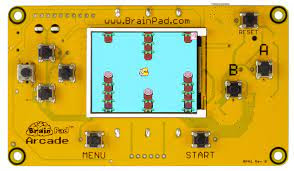
Go to hardware to see the boards on which MakeCode Arcade games run. There are 13 listed at this point, I have one of them, the BrainPad Arcade.

c) Minecraft
Introduction to Computer Science with MakeCode for Minecraft
This is a semester-long course targeted at middle school grades 6-8, as an introduction to Computer Science

11) MicroBlocks, the Internet of Things(IOT) and Raspberry Pi

The developers of MicroBlocks include the lead developers of Scratch (John Maloney), SNAP! (Jens Monig and the Hummingbird Bit (Tom Lauwers) About - MicroBlocks so that alone should tell you that MicroBlocks is special. I had to read an article by John Maloney before I understand how it was special. MicroBlocks supports both live programming and autonomous operation. Users can see and test code changes immediately, yet their code continues to run when the microcontroller is untethered from the host computer

The Activity cards are here. Note that some activities involve the WebThings Gateway on Raspberry Pi.

12) Digital wearables or E Textiles

Stitching the Loop is a fully developed course in E Textiles in which students explore electronic textiles (e-textiles): articles of clothing, accessories, or home furnishings with embedded electronic and computational elements. It meets design, hands on and curriculum integration criteria. For more information watch the video first and then follow the links. Course developers include Jane Margolis who has written a book about why disadvantaged groups don’t get access to computer skills (Stuck in the Shallow End) and Yasmin Kafai who has co-authored a book about why children need to learn programming (Connected Code: Why Children Need to Learn Programming)

Video: Stitching the Loop
Introducing: E-Textiles – Exploring Computer Science
E-Textiles Curriculum & Projects – Exploring Computer Science

I’ve also bought a book by Sahrye Cohen and Hal Rodriguez: Make It, Wear It: Wearable Electronics for Makers, Crafters and Cosplayers (2018) which combines electronics with fabrication technologies such as 3D printers and laser cutters to produce wearable products. Actually, the most commonly mentioned machine in this book is the sewing machine. Just to give you a taste the projects include a Fiber Optic Fabric Scarf, a LED Matrix Purse and others.

13) Tape Blocks
TapeBlock: Creative Circuit Making for All
Creative Circuit Making for All: Including People Living with a Disability
Developed by Dr Kirsten Ellis

I have used these with a Year 7 Down Syndrome girl and she could build and decorate a circuit and explain how it worked. Much more can be done which is outlined at the TapeBlock site.

Saturday, June 29, 2019

educational computing: personal index

In the past 18 months I've resumed my intensive study of educational computing issues, sometimes with a focus on bringing computing to the indigenous and disadvantaged. This is a list of articles on this blog that I've written:

2019
November
The three game changers and disadvantaged youth

October
Integrating the digital technology curriculum with indigenous knowledge systems

September
Digital innovation in secondary education

Indigi digi 2020

August
Proposal for an Australian Indigenous Version of Culturally Situated Design Tools

July
My evolving mangle -> ethnocomputing

Skills and dispositions utilised in simulating a NAIDOC poster using Turtle Art

second iteration of a NAIDOC week poster using Turtle Art

First iteration of a NAIDOC week poster using Turtle Art

How to evaluate construction kits: ten design principles

would you like to see a toilet roll dance?

bee waggle project with the Hummingbird Bit

June
Turtle art: beautiful maths

Making sense of the micro:bit

May
Arrernte Language app

April
My educational computing CV update

New microbit affordances

March
Bushwalking near Alice Springs

January
The teaching of coding

Write your own apps

2018
December
Indigenous icons activity

Help Desk

#thismymob

an old quote from Hal Abelson

November
Inspirational example of making a difference

October
Tangible digital education theory

August
Mobile digital educational

Mobile digital educational course update

Bret Victor

April
Digital Immersion Mongrel Vygotsky

Technology as Trickster revisited

Technology and Indigenous Progress

RACHEL is the answer

Why software might be superior knowledge

Sunday, March 12, 2017

The genuine refutation

"The genuine refutation must penetrate the opponent's stronghold and meet him on his own ground; no advantage is gained by attacking him somewhere else and defeating him where he is not"
- GWF Hegel, Science of Logic: Subjective Logic or The Doctrine of the Notion
Both the critics and supporters of Direct Instruction do not refute from within the others respective strongholds. That is why this quote has been playing on my mind for sometime.

Sunday, January 29, 2017

fork in the road options and Direct Instruction

An attempt at a pithy critique of Direct Instruction:

In Direct Instruction there is no script for those who depart from the script or who desire to write their own script.

I'd rather be a Robert or a Lauren, than an Alice.
Alice in Wonderland

“One day Alice came to a fork in the road and saw a Cheshire cat in a tree. ‘Which road do I take?’ she asked. ‘Where do you want to go?’ was his response. ‘I don’t know,’ Alice answered. ‘Then,’ said the cat, ‘it doesn’t matter.”
- Lewis Carroll
The Road Not Taken

Two roads diverged in a yellow wood,
And sorry I could not travel both
And be one traveler, long I stood
And looked down one as far as I could
To where it bent in the undergrowth;

Then took the other, as just as fair,
And having perhaps the better claim,
Because it was grassy and wanted wear;
Though as for that the passing there
Had worn them really about the same,

And both that morning equally lay
In leaves no step had trodden black.
Oh, I kept the first for another day!
Yet knowing how way leads on to way,
I doubted if I should ever come back.

I shall be telling this with a sigh
Somewhere ages and ages hence:
Two roads diverged in a wood, and I—
I took the one less traveled by,
And that has made all the difference.
- Robert Frost

Saturday, December 31, 2016

Martin Nakata's Disciplining the Savages Savaging the Disciplines

My dissatisfaction with the discourse of culturalism stemmed largely from being certain about who I was (an Islander) and uncertain about why we were treated the way we were. Something about the re-writing of earlier racial discourses into a cultural discourse grated deep within my mind and soul. Why would I accept such a shift that said in effect 'Oops, sorry, we were wrong but we've rethought this and, here, we think this is a better explanation of you and your predicament' ...

In my undergraduate years, there was the possibility that my oppositional stance could have developed into a radically 'dumb' one and at many times sheer anger at our historical circumstances threatened my sanity and my study ...” (pp. 222-3)
What is required to make indigenous education better than it is now?

Martin Nakata describes and traces his alienation within the system. As a helper within schools the whites were only interested in his opinions if they were congruent with their own. Earlier, on as a secondary student, it all felt meaningless, he dropped out and took drugs, for a while. Later, at University, he was very successful, but could not articulate how he felt to others. At one point in this process other Islanders questioned whether he was still an Islander.

How should one respond to being marginalised and alienated by the dominant system?

MN's response was to study and more study to understand the knowledge base of the oppressor. What knowledge base could possess such arrogance as to intrude in every possible way into Islander lives with the casual assumption of superiority. Although overt racism has now been more or less replaced by culturalism (the glib shallowness of they are equal but different, let us respect that difference) but still the dominant culture can't see the world as an Islander sees the world. Ideas about Islanders are expressed by well meaning "experts" with little or no reference to the actual life experiences of Islanders. MNs goal is to comprehend this lack, to come to grips with it.

Moreover, he develops the theory of the Cultural Interface (which it needs to be explained is not a capitulation to culture) as a vantage point for all of us to understand these issues.

So, when I say the book is magnificent I mean that it has personal, political and educational significance which is complex but needs to be thought deeply about. It persuades me that a complex problem, which no one has solved so far, requires a complex solution. So this book has changed me.

The educational implications are that the complexity and curriculum reform (savaging the disciplines) both have to be embraced. Unfortunately, this goes against what normally works in schools, the KISS principle, Keep It Simple Stupid.

Fortunately, some have taken up the challenge: for example, see 8 ways, the YuMi Deadly Centre and ATSIMA. I'm not certain how much of this was started independently of MN but I suspect that he started something important, that his role in all of this has been significant.

Monday, December 16, 2013

rediscovering the purpose of school: reply to Barry York's education revolution article

A response to Barry York's article, Can we have a real Education Revolution?

Barry commences by pointing out that class size has reduced from 50 to 25 over a generation.

It is often claimed, by the political right, that reduction in class size hasn't improved educational outcomes. The statistics support this position of the right. John Hattie has become an often quoted authority about effect sizes:
"... a synthesis of meta-analyses and other studies of class size demonstrate a typical effect-size of about 0.1–0.2, which relative to other educational interventions could be considered ‘‘small’’ or even ‘‘tiny’’, especially in relation to many other possible interventions—and certainly not worth the billions of dollars spent reducing the number of children per classroom. The more important question, therefore, should not be ‘‘What are the reasons for this enhanced effect-size?’’, but ‘‘Why are the effect-sizes from reducing class size so small?’’"
- Hattie, J. (2005).The paradox of reducing class size and improving learning outcomes. International Journal of Educational Research, 43, 387–425
I believe that the Gonski report is yet another iteration of this process. It throws money at schools but lacks an evidence-based plan to actually improve educational outcomes.

Barry fondly mentions "a wonderful History teacher by the name of Itiel Bereson". I agree that great teachers make a difference and that this is far more important than class size.

I also agree that the teachers union plays a very limited and sometimes negative role in real educational reform because they are more interested in teacher conditions than teacher quality. I'm angry at the Union for not supporting performance pay for teachers in remote indigenous communities, conditional on them achieving measurable improvements. If the teachers union had responsibility for determining the nature of teacher training in Universities then they would feel more pressure to actually come up with an educational approach that works, rather than focusing too narrowly on teacher rights.

But when Barry argues that classroom teachers "know best" there is some lack of the clear thinking he extols beginning to creep in. If there are only a few great teachers like Mr. Bereson, one wonders why they as a group "know best"? Barry is expressing the belief here that those who do the real work, those at the chalk face, as a result of their nitty gritty day to day experience, "know best". Yet, if they really know best why do they support a union that focuses on worker conditions, promotes the same green issues that Barry objects to and doesn't push hard enough for quality teaching?

Who really does know best? One group that I have been taking a lot of notice of recently are those who promote evidence-based criteria and have the skin in the game of actually working with and improving the learning of disadvantaged students. In Australia, this would include Kevin Wheldall, Robin Beaman-Wheldall and Kerry Hempenstall as well as the initiative promoted by Noel Pearson in Cape York, using the American derived teaching materials of Zig Engelmann.

Barry goes on to counterpose Learning to Teaching as though there is no real connection between them. Moreover, he claims that the social purpose of schools is to imprison the mind and that hasn't changed for two centuries. This is simplistic argument. As always, the devil is in the detail.

This leads into Barry arguing for the end of learning as we know it and it's replacement with learning over the world wide web. We are led to believe that we can do this now because in C21st we have a "very high literacy". If only this were true. Unfortunately, the literacy rate in Australia leaves much to be desired. Although it has improved massively since the late C19th, the really important measure is whether people have sufficient literacy to be highly functioning members in today's society.

My research indicates that roughly 44% or 13.6 million Australians aged 15 to 74 years have literacy skills that will make it difficult for them to independently extract useful information from the world wide web (source: Programme for the International Assessment of Adult Competencies, Australia 2011-12

Moreover, Australian schools are not doing a very good job in teaching basic literacy. The PIRLS 2011 study into reading comprehension put Australia second bottom of all English speaking countries surveyed. 24% of Australian students had a Low or Below Low score in reading comprehension. See Kevin Wheldall's article, PIRLS before Swine for more detail.

The basic problem is that teachers have not been trained properly to teach literacy. This was the conclusion of the Brendan Nelson National Inquiry into the Teaching of Literacy in 2005 but none of the recommendations from that inquiry have been implemented. The real villains here are the teacher trainers in universities and the teacher unions who block reform. (the education establishment). Many of them are still wedded to discredited whole language approaches.

It has been argued that there are other, more modern forms of literacy than old-fashioned "reading comprehension". These arguments sometimes take the form that it is more important to "read the world" than read the word. But a little thought is enough to convince most people that old fashioned "reading comprehension" is a prerequisite to "really learning" on the Internet.

So, the statistics reveal that at least 44% of adult Australians and 24% of young Australians, still at school, are going to miss out if Barry's model of school reform is implemented. Of course, the internet has incredible learning potential for highly literate and self motivated learners. But Barry has made too many sweeping generalisations in his historical and social analysis of the actual nature of schools. If you are not clear about the actual problem then how can you be clear about a viable solution?

Is it possible to conceive of a useful purpose for schools? Yes, it is. Anthropological findings show that there is no easy or natural path to certain types of knowledge, including reading and writing. This type of knowledge has been called non universals (by Alan Kay) or "biologically secondary cognitive abilities" (by David Geary).

Universal knowledge, displayed by every human tribe, includes such things as:
  • social
  • language
  • communication
  • culture
  • fantasies
  • stories
  • tools and art
  • superstition
  • religion and magic
  • case based learning
  • theatre
  • play and games
  • differences over similarities
  • quick reactions to patterns
  • loud noises and snakes
  • supernormal responses
  • vendetta and more (about 300 of these have been identified across cultures)
The above categorises the level of what most people do on the world wide web (social media), despite it's potential for higher learning.

On the other hand, the non universals include such things as:
  • reading and writing
  • deductive abstract mathematics
  • model based science
  • equal rights
  • democracy
  • perspective drawing
  • theory of harmony
  • similarities over differences
  • slow deep thinking
  • agriculture
  • legal systems
These are much harder to learn than the universals because we are not directly wired to learn them. These things are actually inventions which are difficult to invent. And the rise of Schools going all the way back to the Sumerian and Egyptian times came about to start helping children learn some of these things that aren't easy to learn. For more details about the universals and non universals see The non universals

Some things are hard to learn. Although that hard to learn information is on the internet it is usually not sought out spontaneously by your average facebook junkie. I call the popularity of social media the you_twit_face phenomena (after youtube, twitter and facebook). Pop culture is the main form of discourse on the internet.

Learning to read is rocket science. But once you know how to read you totally forget the process you went through to learn to read. The literate then become blind to the plight of the illiterate. The idea that reading is natural, you just soak it up naturally from the surrounding environment, is BS.

The legitimate purpose of school should be to teach the non universals, the things which are not learnt naturally. That is one reason why schools were invented in the first place. They are not simply vehicles to imprison our minds.

Barry quotes Mao: "If you want knowledge, you must take part in the practice of changing reality". I can agree with the Mao quote but like any one liner it only represents a part of a more complete picture. Mao argued for an ongoing spiral of knowledge between practice and theory. If you are going to take part in the practice of changing reality then you had better also be prepared to study / research hard and acquire a lot of knowledge, including book knowledge. We all know activists who end up doing and thinking foolish things.

In fact, there are many former radicals from the late 60s who went onto become education establishment leaders and union activists promoting non authoritarian, constructivist teaching methodologies such as whole language that have led to a quarter of our students not becoming literate. They have changed reality in a bad way due to insufficient research informed by an intuitive dislike for a form of "authority", mistaking authoritative with authoritarian.

The factory model critique is problematic when applied to education because there is some good education that fits a factory model type of metaphor. Factories in capitalism are bad because they steal from the labour of workers. Another sense in which it is used is the replacement of artisan labour with mechanical labour, but that critique is more problematic according to Marx. There is nothing wrong with a machine replacing what was previously done by an artisan.

Many intelligent people report bad experiences at schools. For example, they were told to do things, such as write answers in sentences, over and over again, something that they already knew how to do and so the experience was boring, boring, boring ...

But, could you have a good factory model in an educational setting? In my opinion, yes. One answer here would be to improve the factory, each student having their own individualised, computerised assembly line programmed to help achieve both essential literacies but also electives beyond the basics.

Another popular, related argument is that individuals have multiple intelligences or different learning styles, which have to be catered for. But those positions have pretty much been abandoned by thinking educators. Lookup Dan Willingham on the net, he is very good at debunking both of those fads (multiple intelligences, learning styles)

Direct Instruction is pretty much a factory model, a far better factory model than what happens in most existing schools, and so the intuitive dislike of it by "progressives" is strong - but wrong. In teaching basic literacy and maths the research shows that one method fits all is a very good way to go. Kevin Wheldall calls this Non categorical teaching.

In conclusion, what is my idea of a good argument for school reform? It's a matter of getting the balance right between components that need to be highly structured and other components enabling freedom of expression. Thanks to people like the Wheldalls (MULTILIT) we now know how to achieve very close to 100% literacy education through a structured approach, an individualised factory model if you will. Direct Instruction models could also be beneficial for highly literate people wishing to extend their knowledge over particular domains, eg. the contribution of Einstein to our knowledge of physics. Beyond that I agree that Barry's ideas have merit. The internet has much potential for extending our knowledge further for those who are literate and motivated to do that. But as Mao also said, you have to lift the bucket from the ground, not start in mid-air.

Friday, November 22, 2013

challenging Sir Ken Robinson

Creativity expert Sir Ken Robinson challenges the way we're educating our children. He champions a radical rethink of our school systems, to cultivate creativity and acknowledge multiple types of intelligence.
- Speakers Ken Robinson: Author/educator
There is not just one but many Sir Ken Robinson TED talks about how the industrial model of schooling is killing creativity in our youth. Everyone loves to hear a story of a maverick but creative individual, such as Albert Einstein, who hated school and went on to demonstrate their genius. "Imagination is more important than knowledge", etc. As TED says there is "deep resonance" with this message.

Sir Ken's passionate polemic has now been challenged. Sir Ken is very popular, much loved but wrong. It's also important to drill down into the details of this argument. This corresponds to meme 5 Creativity of my current research (DI_indigenous_memes) Here are some links, with extracts:
Robinson pegs the current system as a product of the Enlightenment, but curiously the word “Romanticism” never comes up. Romanticism was an intellectual movement of the second half of the 18th century that arose in response to the rationalism of the Enlightenment. It elevated emotion and feeling, and also emphasized the sublimity of Nature and all things natural.

Indeed, Romanticism gained strength in reaction to the Industrial revolution, the very movement that Robinson criticizes as an inspiration of our erroneous education paradigm.

Romantic views of education, typified by Pestalozzi and Rousseau, emphasize personal experience as crucial, and decry the sublimation of the individual to conformity. More generally, progressive educators from the early 20th century to the present have emphasized instruction that follows the child’s interests, includes more real-world tasks, and more group work.

So Robinson is not suggesting a revolutionary, entirely new approach. In fact he’s tapping a very rich, very old vein of thought.

It’s not important to me that he fails to acknowledge his intellectual forbears. It’s important to me that he fails to acknowledge that many many people have tried to create schools inspired by these ideals before. A few were spectacular, inspiring successes. Most crashed and burned. And, as is so common, what made the successes work well seemed difficult to pin down, and dashed attempts to replicate the success elsewhere.

I want Robinson to tell me what’s going to make things different this time around.
Willingham: Is a paradigm shift really needed?
On reflection, creativity appears to me a grittier, tougher process than such talks imply. Thousands of hours of ‘deliberate practice’ enable creativity. It is not all ‘flow’ or organic personalisation. For example, repeating the rules of grammar with sometimes deadening repetition can actually create the mastery required for playful creativity and rule breaking. Sir Ken likely scripted and practised his apparently spontaneously witty talk over and over to create his seeming carefree confidence and fluency. The pleasure of finding ‘flow’ is replaced by the dull but reassuring knowledge that perseverance could help make a difference, in a ‘factory model’ school or not.
Why we should mistrust Sir Ken Robinson
People like Robinson seem to believe that our jobs as educators is to uncover the talents and aptitudes personal to each child, and then to elevate them. This assumes that such aptitudes exist, uncovered, undiscovered, like statues of David buried in cold lava, and our jobs are to be archaeologists of character. Who buries these statues? What fairy hand blesses each child with gifts, and then challenges its guardians with discovering them? What immortal hand or eye?
- The Second Coming of Ken Robinson- but he's not the messiah
1. Talent is not innate

A growing body of research shows that talent isn’t innate, waiting passively like a tooth ready to be extracted. Research collated in books from Malcolm Gladwell, Carol Dweck, Matthew Syed, Daniel Coyle, Geoff Colvin, Daniel Willingham, Doug Lemov and Paul Tough show that natural talent is a myth; it’s only dedicated, determined and disciplined practice that leads to great achievement.

2. Multiple intelligences don’t exist

Dan Willingham has summarised the research and shown that learning styles do not exist; on multiple intelligences, ‘for scientists, this theory of the mind is almost certainly incorrect’: ‘The fact that the theory is an inaccurate description of the mind makes it likely that the more closely an application draws on the theory, the less likely the application is to be effective. All in all, educators would likely do well to turn their time and attention elsewhere.’

3. Literacy and numeracy are the basis of creativity

In the UK, 17% of school leavers leave school functionally illiterate, and 22% leave school functionally innumerate. Ask any parent what they would prefer: that their child left school unable to read, write or add up but able to dance and draw creatively, or unable to dance or draw creatively but able to read, write or add up. The reason why there’s a hierarchy of subjects is because some are more empowering than others. If you can’t read, you can’t learn much else. If you can’t do arithmetic, you can’t become a teacher, doctor, engineer, scientist, plumber or electrician. Numeracy and literacy are complex evolutionary applications of civilisation; they take a great deal of time, practice and expert guidance to master, so we dedicate a lot of time to them in school, and rightly so. Sir Ken is wrong when he says children do not need to be helped to learn, for the most part: children do need to be helped to learn – every teacher knows that. We don’t dedicate so much time to dancing and drawing because they don’t disempower you so much if you can’t do them.

4. Misbehaviour is more damaging than conformity

In any classroom, without compliance with instructions, no one learns anything. Disruptive behaviour is chronic, particularly in the most challenging schools. The problem for many teachers is not so much conformity, but rather pervasive disruption to teaching. Self-discipline is not an evil weed to be uprooted, but the foundation for effective learning. But then again, Sir Ken has not been teacher in a tough school – nor any primary or secondary school at all.

5. Academic achievement is important, but unequal

Strong academic achievement in private schools allow 96% to go to University, and in the UK commandeer 70% of the jobs as high court judges, 54% of the jobs as doctors and 51% of the jobs as journalists, despite only educating 7% of children. Yet only 16% of the poorest pupils go to University, due to persistent academic underachievement. It’s no good Sir Ken disparaging the education system’s focus on academic ability; closing the gap in academic attainment is vital for social mobility, social equity and social justice in this country.

6. Subject knowledge is vital for critical and creative skills

Decades of scientific research shows the importance of broad and domain-specific knowledge for reading, critical thinking and problem-solving skills. So it’s no good Sir Ken disparaging subject-based curricula. All over the world, mastering subject disciplines is the route to success. It’s no coincidence, no middle-class industrial Victorian conspiracy that China, South Korea, Canada and Scandanavia all organise their systems like this, as global expert Tim Oates explains: ‘In all high-performing systems, the fundamentals of subjects are strongly emphasised, have substantial time allocation, and are the focus of considerable attention’. It’s the most effective way of organising teaching and learning, because, as Daisy Christodoulou explains: ‘thinking skills are subject-specific; our working memories are limited and easily overloaded by distractions; and pupils are novices,’ not experts, and so require expert guidance.
What Sir Ken Got Wrong
I don’t completely agree with all of Pragmatic Education’s arguments (referring to the link above)
  • Intelligence may not be malleable. You can learn more knowledge, and that can come from practice. It’s not clear that fluid intelligence is improved with practice.
  • Learning styles don’t seem to exist. Multiple intelligences? I don’t think that the answer is as clear there.
  • Creativity comes from knowing things. Literacy and numeracy are great ways of coming to know things. It’s a bit strong to say that creativity comes from literacy and numeracy.
  • There are lots of reasons why rich kids are unequal to poor kids (see the issue about poverty and cognitive function.) Cultural knowledge is just part of it.
But 90% — I think he gets what’s wrong with Sir Ken’s arguments. What Sir Ken Got Wrong, and what the blogger got wrong too
Note: I haven't replicated the links in quotes from the above blogs. Many of these links are valuable. You will need to visit the original blogs if you want to research this further.

Wednesday, November 13, 2013

Direct Instruction may spread throughout disadvantaged Australian schools

It's happening. The Direct Instruction educational methodology initiated by Noel Pearson in some Cape York indigenous schools will be spread to other disadvantaged schools throughout Australia by the Abbott government.

Some extracts from the article in today's Australian, (the link is behind a pay wall), Noel Pearson's Cape plan can help all disadvantaged kids by Patricia Karvelas, with some questioning footnotes by me.
THE radical direct instruction teaching model has transformed education in Cape York communities and could benefit disadvantaged children across the country, says the parliamentary secretary charged with helping Tony Abbott deliver his indigenous affairs agenda.

Victorian MP Alan Tudge, who has just completed a trip to the Cape York community of Aurukun, where direct instruction is operating, says although formal data is inconclusive (1), he was overwhelmed by the difference he saw at the schools.

The Prime Minister has approached Cape York indigenous leader Noel Pearson to review the education of all disadvantaged and impoverished children and explore rolling out the direct instruction teaching model in schools across the nation...

"School attendance has improved markedly and kids are clearly engaged and learning," Mr Tudge said. "While the formal evaluation, released two months ago, was inconclusive due to lack of data (1), there is certainly great optimism by many about the direct instruction method coupled with strong attendance measures." ...

Mr Tudge said the government would commit $22 million to support "proven explicit teaching methods" into other schools. "We are also absolutely determined to ensure that school attendance is improved," he said. "We need to do things differently because there are systemic breakdowns in many places where kids are years behind or functionally illiterate when finishing primary school.

"It starts with attendance; no child will keep up if they are only attending half the time. In the Northern Territory, only 13 per cent of remote indigenous kids are attending 80 per cent of the time (2)"

Mr Tudge said research suggested explicit, phonics-based teaching methods were necessary for children who were behind or struggling. "The strength of the direct instruction model is that it appears to be a system that can be replicated and is not reliant on a single brilliant individual or team to make it work (3)," he said.

Mr Pearson said that when the Cape York Aboriginal Australian Academy was set up in 2010, the three schools involved were among Queensland's most disadvantaged "but one of them, Aurukun, was undoubtedly the worst school in Queensland".

"Our goal was to turn these poor schools into fair schools," Mr Pearson said. "And then we want to turn fair schools into good schools. And after than we want good schools to become great schools (4). I am very confident after three years that Aurukun is now a fair school. That means if you send your child to that school, your child will receive the education he or she deserves.
(1) If formal data is inconclusive then that is a big worry. Alan Tudge's feeling about being overwhelmed at the differences he has seen is unfortunately not good enough. The history of educational reform is that new methods have been used, sometimes for decades without clear evidence that they work. The research base for effective teaching does need to be clear.

(2) Getting kids to attend remote indigenous schools is a major problem. As well as having good schools that are worth attending (the pull factor) the problem of having parents being committed to send their kids to school is just as important (the push factor). The way this is being tackled in Cape York is through the Family Responsibility Commission. See Catherine Ford's brilliant Great Expectations essay for more details about how problematic this issue is.

(3) I agree strongly with this point. Other methods might work but they don't scale to mass delivery because of their complexity and / or reliance on a brilliant or inspirational teacher.

(4) While agreeing that Direct Instruction (and MULTILIT) is great teaching the basics I'm wondering if Noel Pearson is thinking that other methodologies may be also required to make the transition from fair to good to great. This would be consistent with the dialectical "radical centre" thinking articulated in some of his essays.

Update (13th November): Evaluation of the Cape York Aboriginal Australian Academy Initiative for Department of Education Training and Employment Queensland. Prepared by Australian Council for Educational Research, June 2013 (pdf, 93pp)

Wednesday, October 16, 2013

the elephant in the classroom (Kevin Wheldall)

Fortunately, all of chapter one is available through google books: Developments in Educational Psychology (Second edition published in 2010)
What then is the elephant in the classroom? The unspoken (or rarely admitted) truth is that educational progress is not being delayed because of a shortage of funding for schools. Children's school performance is not being impeded by their being too few teachers. Educational standards are not slipping because parents do not care and students are lazy these days. The elephant in the classroom, that many educationalists claim not to see, is that the quality of teaching in our schools is simply not good enough. It is not good enough because it is largely based on educational theory and methods for which there is little or no empirical supporting evidence for efficacy or which have been discredited. The education provided to children in our schools is largely ineffective because the education system ignores the extant scientific research evidence on what we know to constitute effective instruction and best teaching practice.
- from Chapter 1: When will we ever learn? Or the elephant in the classroom by Kevin Wheldall
Read the whole chapter through the link above. I am so impressed by Kevin Wheldall's writings. I picked up a second hand copy of this book through amazon, here, for $18 plus $18 shipping.

Thursday, October 03, 2013

Direct Instruction Indigenous Meme Warfare

I've uploaded the outline of this research proposal at the learning evolves wiki: DI_indigenous_memes

DIRECT INSTRUCTION FOR INDIGENOUS STUDENTS: A CASE STUDY IN MEME WARFARE (RESEARCH PROPOSAL)

CONTEXT: appalling basic literacy and numeracy rates amongst indigenous Australians, especially those who live in remote regions.

PERCEPTION: We literally see the world according to the memes in our minds

The Direct Instruction (DI) approach is a good attempt to solve a number of practical problems that arise for teachers of severely disadvantaged students who have poor skills at reading, writing and comprehending English and Maths.

HYPOTHESIS: Many can't see the value of DI because of the synergistic influence of a plethora of mind memes which act as blinkers and filters to influence their perception. The rejection of DI is not based on research or science as is claimed but results from a deep, internally coherent world view. ie. the rejection of DI is more part of a cultural, psychological, philosophical and political world view and not scientific as is usually claimed.

The memes are grouped under various subheadings: (1) culture, (2) rights, morality, compassion, justice (3) social class, (4) "real learning", (5) creativity, (6) philosophy, (7) institutionalised inertia and (8) computer lib. The identified memes are often associated with a "progressive" world view / education and form a large part of the cultural background of "progressives". It will be argued that some of these memes are refutable, some of them are valid in a more general sense but not in the particular context being discussed (basic education of severely at risk students) and some are more or less correct and should contribute to the educational environment that ought to be developed. However, when combined together synergistically these memes are likely to evoke a critical response to DI in any context and act to block its possible implementation. The critical response is often emotionally charged, that is, part of a culture war.

WHERE IS THE ARGUMENT HEADING?

Try to imagine the process involved in changing from the anti DI mindset to a pro DI mindset, or vice versa for that matter.

Discussion points arising -

Self awareness and self examination of one's own deeply held biases or beliefs is a difficult process

When people argue that science or evidence supports their viewpoint what does this mean? This requires not only looking at the evidence but also looking at the model of science that is being evoked here

In a few of his essays Noel Pearson outlines the dialectical concept of the radical centre where the best elements from both sides of the political divide are combined into a coherent policy. Yet it could be argued that his currently favoured educational policy, Direct Instruction, is going too far to one side of such a centre.

Direct Instruction (full immersion) is an educational framework that can transform a community of poor learners to become fair learners. Naturalist approaches such as unguided constructivism have failed. Nevertheless, there are limits to Direct Instruction and a framework of guided discovery to promote higher learning is outlined (based on the educational ideas Montessori, Bruner and Vygotsky).

Wednesday, May 15, 2013

Inspirational article about the *real* Education Revolution in Cape York by Nicolas Rothwell

Controversial teaching method brings hope and social change to Cape York
Nicolas Rothwell From: The Australian May 11, 2013

"GET ready!" A hand-clap. The children lean forward in their seats, expectant, alert.

"What colour?" their teacher calls out. "What number?" The replies come back in unison. The mood is focused; the pace swift. New words, facts, concepts are brought in one by one, and reappear all through the lesson and reinforce each other. This is concentrated learning, with a swing and urgency about it.

In a small classroom in Aurukun on the west coast of Cape York, step by step, the everyday wonder of Direct Instruction is unfolding. Here, in the far reaches of far north Queensland, in a remote Aboriginal community, something remarkable is taking place: young boys and girls are at their desks, studying, writing, absorbing every piece of knowledge offered them. It is the dream that has seemed beyond realisation in recent years: a remote-area indigenous school where the students are bound for success. Is the dream at last being fulfilled?

Aurukun is the showpiece campus of the Cape York Aboriginal Australian Academy, key project of the region's great reformer, Noel Pearson: a school run almost entirely on the basis of the Direct Instruction system; a school already much inspected and evaluated, eagerly praised and pre-emptively critiqued. But only now, two years into the venture, is there something of substance to assess: data, initial evidence to go with the impressions that days spent in the classrooms leave in the mind.

First, though, the strange backstory: the tale of how Direct Instruction, "DI", an American teaching method pioneered in Illinois and Oregon, and much used in public schools in US inner cities, came to Cape York. The story is bound up with Pearson's path in life. Mission-born at Hope Vale on the Cape's east coast, gifted, given educational opportunities, he went to boarding schools and to university, became a lawyer, and made his name, while still young, as a native title advocate.

Then he changed priorities. He went back to far north Queensland. His home region was in crisis. The chief causes were plain to him: alcoholic drinking, passive welfare provision and a breakdown in schooling. Pearson devised a comprehensive strategy for social change, and after a long struggle on the battlefield of ideas persuaded governments and senior bureaucrats to back his vision.

Four communities opted in: Hope Vale; the little, range-surrounded town of Coen at the heart of the Cape; Mossman Gorge near Port Douglas; and the large settlement of Aurukun, home and capital of the Wik people. The Cape York welfare reform trial began in mid-2008: its key innovation was the Family Responsibilities Commission, a panel of local leaders with the power to impose income management on community members whose actions are doing harm to those around them.

The trial had many facets. It included measures for financial management and home improvement, but at its core was an even more ambitious reform plan: Pearson's blueprint for a network of top-flight primary schools, and an academy, with high aims and concrete proposals to realise them. From his own experience he knew that education liberates. Get the schooling right, and anything is possible.

What would be the best replacement for the long-established, lacklustre approach? He had investigated teaching models: promising schemes and remedial programs, motivational initiatives from around the world. One stood out: DI, the brainchild of a most unusual professorial pioneer named Siegfried Engelmann.

Pearson recounts his discovery of DI and the development of the Cape York Academy concept in a slim book he published two years ago, titled Radical Hope. It contains a brief afterword in which the very first field reports from the DI classrooms are set down.

They were positive, and even then Pearson was optimistic, with good reason. DI is straightforward, and based on close study of the way a child's mind works. It is a teaching method, as well as a tightly controlled curriculum. Above all, its track record proves its effectiveness. It works wherever it is properly implemented: in the poor suburbs of Atlanta, Georgia, where Cape York community leaders saw it in action on a study tour; in the disadvantaged regions of the US Midwest; in native-American schools in Arizona and New Mexico.

Pearson was also confident in the group of educators he had assembled. The first executive principal of the academy, Don Anderson, was one of the most admired figures in Queensland's education system. Anderson had become convinced DI had something to offer, and that the old model had failed, for tangled reasons. He had spent his working life in remote schools: at Lockhart River and Aurukun and Weipa on the Cape, at schools and colleges in the Torres Strait. He knew the trends.

"I had watched a continual decline over years," Anderson says. "A decline both in educational outcomes and in opportunities for indigenous children.

"And now, being involved in the first sustainable, significant recovery in schools performance, I'm more than happy to admit that much of our hard work in the past was misdirected and ill-conceived, even though we were giving 110 per cent."

Anderson grasped, then, the need for change, and the rationale, but he had to find a crack team to introduce it. And so, in early 2010, as soon as the deal to launch the academy model at the schools in Coen and Aurukun was struck, he placed a call to a handful of dedicated remote-area teachers, including one named Patrick Mallett, an individual with a pronounced taste for challenges. Mallett, today the principal at Aurukun, remembers driving in to the community that February, beneath wet season storm clouds.

"I arrived. Was this it? It was bizarre. There were children wandering about in the school grounds, a crowd of them were playing on the roof in the middle of class time. I'd never seen a campus so disengaged. Dysfunction permeated the whole place, it didn't feel like a school at all. The task seemed Herculean. But day by day, week by week, we began, we made progress. And for the children the penny dropped relatively early on that their teachers were now taking their education and advancement absolutely critically. Once they worked out that they could actually learn to read and write, their self-esteem rocketed."

Those early successes did not come merely from following a tuition model brought in from outside. Great care went into the design of the academy's curriculum, which is now also taught in the large school at Hope Vale.

It has three components: "class", the core DI program, which delivers 20 hours of literacy and numeracy teaching every week; "club", which gives lessons in sports and music; and "culture", a subject-group that includes local languages and traditional and environmental knowledge, and has a syllabus designed by the academy's own team. Club and culture are taught after normal school hours, in optional lessons that extend the school day by 90 minutes: attendance is almost universal.

A process of constant student assessment is at the heart of DI. Each child must learn each lesson, and achieve mastery, in reading, in writing, in the new concepts introduced in class every day. Individual tests are quietly administered to check progress every week. At the week's end, the teachers make a call to their American DI learning colleagues to go through the results. Each student's performance is checked. If a child or group of children lag in any area, they are split from their class and taught in a new group: they will not be left behind.

There are other safety nets. Regular attendance is one obvious key to classroom success, and in remote communities typically it is the chief problem. At Aurukun, a pair of dedicated case managers watch the school gates every morning, then travel round the community to seek out the no-shows. Any child who comes in more than half an hour late goes on a watch list. Three late days in a row triggers a referral of their parents or guardians to the Family Responsibilities Commission. This measure has helped lift attendance to 75 per cent.

Maryann Kerindun, both a traditional owner of land estates near Aurukun and a long-time teacher assistant at the school, can see the difference. "In the old curriculum, we had problems," she says. "A child could not recognise a letter; a child could not recognise a number. Learning struggled through those times.

"Then the changes began with this new system. They've come a long way. With this new set-up, with this DI in the classroom, you see the children focused, they're blossoming, they're surprising their own families."

The experience has been similar at the Coen campus, which began DI instruction at the same time, early 2010. There, Billy Pratt, a local with three children at the school and one in daycare, about to begin classes, has come to believe in the new system. Pratt is a member of the academy board, and heads a new regional ranger group. He looks back to his own childhood, when he had to rely on outside mentors to make progress.

"One thing we could never figure out was how come a teacher could achieve in the mainstream schools, but not here, in the bush," he says. "Now DI has come in, I think it works because of the method, and the constant testing and measuring. They don't let the students go from grade to grade without picking up anything.

"My children get a much better learning experience than I did. You need to stretch children: I want mine to be engaged, not get bored and rebel. My second, she's two years ahead of what's expected for a child her age. She comes home and wants to teach us; she's embraced it."

DI has its critics: fierce ones, who object to its use of textbooks with American examples, or contend that its scripted lessons reduce teachers to a robotic role, or argue that its field results in the Cape York setting are equivocal.

The view among the teachers is rather different. The pattern now in Aurukun, by no means an easy posting, is for frontline staff to stay much longer than the two-year minimum they initially sign on for. "We've lived it, we see it every day," says the head of the DI team at Aurukun, Naomi Gibb. "If I hadn't experienced this over the last 3 1/2years myself, I'd be sceptical. This whole model is building an intrinsic drive in students."

Other teachers speak admiringly of the determination their students show to get to school. The backdrop of their lives may include sleeplessness and domestic troubles: still they come. They come not for metronomic instruction but because the spark of curiosity has been lit in them.

DI lessons, as witnessed in the classrooms of the Cape, are a striking affair. A sense of excitement is present, and also a mood of harmonious forward momentum. Coen's teaching principal, Craig Jordan, argues that "DI has taken the focus off what you teach, and on to how you teach". The executive principal now overseeing the entire three-campus academy, Cindy Hales, is convinced this aspect of the method is central to its effectiveness. "Just because DI's scripted doesn't mean there's no life or heart," she says. "It's a kind of persuasive acting, a drama that makes learning live in the minds of children. People think it's easy and rote just because it's written down - but the hardest part is the transition to a learning life in the classroom: it's hard, good work."

This strong sense of purpose fills the schools. Motivation and positive reinforcement are taken seriously: the entrance hallways are festooned with examples of standout work. The ultra-Pearsonian credo of the academy - "Get Ready. Work Hard. Be Good" - is displayed everywhere, as are lists of benchmarks and goals. "Terrific work-books in Miss Grace's classroom," proclaims one notice, and there they are, photocopied and affixed, examples for emulation - long cascading sentence sequences in neat copperplate handwriting.

In class, the messages are much the same. Courtesy mingles with high expectations. "Boys and girls, you did that exercise so well: now, what are the things we do to be respectful? Teaching, listening, not talking. Good, good, Elspeth, I can see you're reading; and you too, Wilfred, with your finger, tracking." They are the atmospherics of the well-run schoolroom, completely normal and, in the context of a remote community, very rarely seen.

How to measure the vast collective effort engaged in by the academy's designers and staff, and by the children and families whose support lies at the project's heart? How to catch the alchemy that has brought hope and self-belief to communities long used to the lash of media stereotyping and negative publicity? What table of statistics records that? But testing and evaluation are constant features of the education landscape, and the academy, as an institution that inevitably serves to highlight the shortcomings of the status quo in remote community schooling, has been subject to intense scrutiny.

Much is riding on its performance. Experts from the bureaucracy are watching; critics of Pearson and his broader social intervention programs as well. Both Julia Gillard and Tony Abbott are supporters of the scheme. The Prime Minister was instrumental in persuading the then state premier, Anna Bligh, to provide the initial three-year tranche of funding, $7.72 million - still the only large support the academy has received. The Opposition Leader led a team of corporate high-fliers on his "bricks and mortar" library-building working bee at Aurukun a year ago.

Hence the keen interest paid to the latest round of results in the National Assessment Program - Literacy and Numeracy, for the three academy schools when they appeared last September; hence the disquiet when some of the figures from Aurukun showed a mild decline in performance in some subject areas. Less attention was paid to the spectacular test results from Coen, which had been a school with high attendance rates even before the switch to the academy template: it was the best-performing indigenous-area school in Queensland, with all students achieving scores "at or above national minimum standards" in 10 out of the 15 test categories.

For Aurukun, the starting point had been very different: in early 2010, almost all the students were reading at kindergarten levels, or below, and attendance levels were abysmal. In such small campuses, NAPLAN's sampling may record little beyond the variations in the performance of individual pupils in different years.

There are other measures that track the gradual progress of the students at the Cape York schools, rather than seeking to judge their capabilities in a single snap test: both the routine internal monitoring and the Queensland Education Department reviews are favourable, while a forthcoming Australian Council for Educational Research report is expected also to highlight the state of progress in clear fashion.

The academy has always seen its project as a long-term remedial venture: its prospectus warns that it "does not expect significant gains in NAPLAN results until 2013-14, allowing children, especially older children, at least three full years to catch up to grade level". Consistent with this, the best performances at all its schools are among the youngest students, with the least pronounced educational shortfall to overcome.

Given Pearson's profile and the high stakes attached to the overall Cape York Welfare Reform scheme, cool assessment of the DI curriculum's long-term potential seems all the more important. For the academy is part of an experiment with both educational and political resonances. The Cape York Institute's linked projects are aimed to recast the economy of a remote region, invigorate a society trapped by passive welfare systems and inject a note of hope into its young generation through concerted learning programs.

The link between education and welfare reform is a bond. The schools rely on the parental discipline the Family Responsibilities Commission helps impose: and the academy aims to send its students away to boarding facilities at the secondary level, before they return to take up jobs in a revitalised local economy.

There is, though, one telling difference between the welfare reform initiative and the academy, and it explains their relative effectiveness: the multiple welfare reforms are opt-in, and secure limited participation; the schools are the sole providers of primary education where they operate.

The wash-up? Increasingly, those close to the academy believe they have found a wondrous weapon in the fight to strengthen remote indigenous communities: a tool to reverse the pernicious effects produced by two generations of poor learning.

Patrick Mallett, surveying his quiet, well-ordered school grounds at Aurukun, says: "When you have the right curriculum, the right approach and the right structures, you get the community on board, and it happens. I came very quickly to realise that DI was a miracle that had dropped out of the sky, and the people here were the best I'd ever worked with. We've stumbled on the solution to what has been perplexing the rest of Australia."

In the communities, a sense is dawning that the schools can develop into instruments for large-scale social change. At Coen, teacher aide Majella Peter is studying for an education degree at Deakin University and watching the classroom progress of her daughter, now in Year Three. "For me, as a parent, seeing DI opened my eyes: it actually works in lifting literacy and numeracy, and young mothers in this community know it's working."

Peter wants to be a lifelong educator, teach for a decade at the school, become principal there and then open an adult learning centre. "That would be my personal goal: I see my relations living on Centrelink and I feel for them; they can't go forward because they don't have much education, and I feel that could be part of the reason they don't have their life straight - and maybe in time, maybe, if they're responsible, they can straighten their career paths and look to the future."

At Aurukun, Maryann Kerindun has also seen things she never thought she would. "What blows me away is having my grandchild coming home and saying to me, 'Let's read together'. That's the most amazing thing that's ever happened to me, to be able to see that with my own eyes." A further vision shimmers into view, and seems more than a dream: "I want to see a qualified nurse from this community working at the clinic, a qualified CEO, a teacher, a mechanic, a doctor, and a self-managed community, and I know now it can happen. I want to see our future generations run the school."

With early word of the changed atmospherics in the academy schools beginning to spread, education bureaucrats, indigenous leaders and policy thinkers from across the country have begun to take note, and make visits, pilgrimages to the Cape: delegations have come from the Kimberley, northeast Arnhem Land and the Pitjantjatjara region.

The then chief executive of the Northern Territory's Education Department, Gary Barnes, a Queensland veteran recently placed at the helm of the entire Territory public service, brought his key indigenous policy advisers on an inspection tour in 2011 but this keen interest has yet to translate into action, and it is hard to picture regions lacking the leadership of Cape York adopting the academy model, backed as it is by the overarching, regulating mechanism of welfare reform.

DI, though, has evident potential as a teaching method of proven adaptability, and Pearson and his advisers have put forward a proposal to set up an Australian Institute for Direct Instruction, in partnership with Engelmann's Institute in Oregon. The story is at its beginning: the academy hopes, in due course, to extend its operations to between six and eight schools in the Cape, to achieve economies of scale.

If the promise of a new approach to remote-area learning is in the air, and the progress of DI on the Cape is a fascinating case study for southern experts, it means much more elsewhere. Aurukun and Coen are not just possible examples for other communities, intriguing options; they are hope, new pathways made visible. For everyone aware of the bleak lives being given form today in half-empty classrooms the length and breadth of remote indigenous Australia, the question of schooling models has a sharp edge.

Even those who were at first sceptical on the ground have swung about, as if the longing to believe there could be a light of promise has at last vanquished the ingrained expectation of failure, eclipse, and another new program to replace the one before.

Here is one of the most prominent woman leaders of Aurukun, the redoubtable Maree Kalkeeyorta - sister of the strong-minded Gladys Tybingoompa, who danced on the pavement of the High Court in Canberra on the day the Wik won their native title case almost two decades ago.

"I didn't like these changes at first, but I see things now. My sister wanted our children to learn, and I too. English, and our own Wik language way as well. We want the two. Our own way, and the way of outside Australia.

"I think life will improve now for the next generation. Look at them! They laugh, and smile, they love their school, you can see the happy faces. As long as it takes them, they'll follow their path now; they have a path. Every individual child has a pathway to go down, but it's going to start off in this schoolground first."

Wednesday, March 27, 2013

bad news from Cape York

There was a report in today's Australian (Campbell Newman axes Noel Pearson's funding) that the Campbell Newman government in Queensland is planning to withdraw their share of the funding (it is jointly funded by Federal and State governments) from Noel Pearson's Cape York Direct Instruction education programme and Family Responsibilities Commission which supports that programme. The four communities involved are Aurukun, Hopevale, Mossman Gorge and Coen.

There is a pattern involved here which I have seen before. An innovative and successful programme is created by someone with passion and intelligence. Then a bureaucrat or bureaucracy who doesn't understand the issues shuts it down.

Lets hope that this can be turned around.

Sunday, March 17, 2013

education reality check from Dean Ashenden

Dean outlines some of the things we have to think about before we think about actually improving the learning of Australians
  1. The outrageous behaviours of the 3 sectors: Private, Catholic, government
  2. More competition is not a magic bullet
  3. Throwing money at the problem won't work
  4. Productivity talk misses the main point: education is an important human right
  5. The technological revolution needs to be incorporated (somehow)
  6. Improve quality for all, not just teachers
  7. Gonski is already eviscerated
  8. Reality check: ED is a mess
Rules of engagement to survive schools debate
Dean Ashenden, The Australian March 16, 2013

IF Kevin Rudd and Julia Gillard have done nothing else, they have certainly got us talking about schools. Everyone wants to have their say about what's wrong with schools and how to fix them, not just the politicians but grandees of print journalism, stars of national radio and television, leader writers, economic commentators and whole fleets of bloggers, enough in total to drown out the familiar drone of the interest groups and old education hands like me.

Those of us who have been writing about or agitating in schooling forever have our own well-worn ways of getting it wrong, not by what is said so much as by what isn't. Unfortunately these selective habits are often recycled and amplified by the arrivistes.

There are still six long months to go before we can all stop talking about schools, so here are some dos and don't's for the meantime.

First, do not talk about the outrageous conduct of the independent schools (the rich ones especially) or the Catholics (the bishops especially) or of the government sector (unions especially) without saying why they are behaving outrageously. They are doing only as they are encouraged, required or allowed to by the world's worst-practice Australian system of sectors: three funding sources mixed in three ways for three groups of schools governed in three ways.

The sector system is guaranteed to produce adversarial conduct on all sides and hence chronic special pleading, misleading "facts" and a culture of complaint.

Second, do not suggest that more competition between schools or sectors will improve the situation unless you are prepared to talk also about how to make it a competition that everyone, or just about everyone, reckons they can win (as in the AFL, for instance). That would mean, among other things, setting ceilings to spending by schools as well as floors of the Gonski kind, and common rules on things such as cherry-picking students and booting them out.

Third, do not talk about the (manifest) need for more or more fairly distributed public money unless you also are prepared to talk about how to make better use of them.

In particular, have a good answer to the question of what it is that the public got by increasing per pupil expenditure on schools by 2 1/2 times (in real terms) in the 50 years to 2004 (without any improvement in the salaries and status of teachers).

Fourth, do not justify more spending on schooling on the grounds of its productivity.

It's a half-truth anyway (schooling is more about scrambling for a share of a growing cake than about growing the cake) but, even if it weren't, the argument for more and better schooling isn't that it's good for the economy. The central point is that it's better to understand how the world and its numbers and words work than not, and that if you don't, you're legless.

Fifth, don't talk about the virtues of tried and true methods in the classroom unless you can also suggest how they will accommodate the coming technological revolution in teaching and learning. Machines are capable of substituting for the labour of teaching, and will soon be more so. Think of schooling, think of the waterfront, or dead country towns, or Fairfax, and then tell us how teachers should teach.

Sixth, for these and other reasons, please do not talk about teacher quality unless you talk also about the quality of the workplace and the work process of the teacher's 25 or so co-workers. The classroom and the lesson are inherently hard to manage ways of organising time, people and work.

So, if you must talk about teacher quality, please attend also to the quality of students' and teachers' working lives and the need for work process and workplace reform. (And be ready to say where you will find the money to give teachers a very substantial pay rise.)

Seventh: if you must talk about Gonski (and we must) please note the following. Gonski is already eviscerated: by his riding instructions (no school will be worse off), by the Prime Minister's upgrade (every independent school will be better off), by the states' refusal to wear Gonski's proposed national schools funding body, by the Catholics' insistence that money for need should be spread across half of all schools, not Gonski's quarter, and by the government's idea of phasing it all in by 2019.

An eighth and last suggestion: whenever you write about Gonski, or equity, or productivity, or funding, or competition, or anything else to do with Australian schooling, please take a sentence or two to explain that we're in no shape to do anything much about any of these things.

For the first time, Australian schooling faces the common external challenge of international performance comparisons but it has no capacity for a common response.

The system is divided into three sectors in each of eight states and territories, subject to the close involvement of nine governments and their electoral timetables and annual budgetary games.

As Gonski's fate sadly demonstrates, the system is incompetent. It's the system that's letting the side down, not the schools. So, when you write about fixing schools, please remember to mention the idea of fixing the machinery that is supposed to fix the schools.

Dean Ashenden has been a consultant to many state and national education agencies.

Tuesday, November 06, 2012

how many of your teachers made you think?

Critical thinking critical to teaching by Damon Young

This article examines teaching from a philosophical perspective. Read the whole thing.

A teacher: "I don't want to think"
Gilbert Ryle, in The Concept of Mind, distinguished between 'knowing that' and 'knowing how'. The first is factual or abstract knowledge. The second is a skilled disposition. For example, one can know that Hume was an empiricist and sceptic, simply by reading a sentence in a first-year textbook. This is very different to knowing how to think empirically and sceptically.

And to develop this disposition, it is not enough to memorise rules about fallacies and syllogisms. "We learn how by practice, schooled indeed by criticism and example," writes Ryle, "but often quite unaided by any lessons in the theory." One must actually read, think, formulate arguments, listen, reply, and so on. It is an achievement developed within a very specific community, and requires as much collaboration as conflict.

A secondary teacher who does not "want to think" will not provide these conditions. Students might know that Caesar crossed the Rubicon in 49BC, that mitochondrial DNA is maternal, and that Socrates spoke negatively of the life without examination. But they will not know how to think about these; how to do historiography, biology or philosophy.

And because the teacher is not an exemplar - perhaps the most powerful way to communicate intellectual virtues - the students might never recognise that they missed out. They might graduate without having witnessed critical thinking in teachers or one another. And then the onus is on TAFE, university or the workplace to provide the conditions - sadly, not always a certainty.
At one stage in my life I thought that by promoting philosophical thinking amongst teachers then the quality might improve. Eventually I realised that if government allows input into the profession from those with rather low TER scores, some of whom chose teaching because other "more attractive" career doors in business, engineering law and medicine have closed, then the prospect of philosophy turning things around became incredibly low.

In turn this becomes part of a good argument for scripted lessons, since most teachers as well as not having the time also don't have the inclination or ability to research a subject domain thoroughly and then develop their own high quality curriculum.